Oct 30, 2026Sourcing Guides
Inside a Licensed Accessories Factory: Scale and Authorization
More than 800 staff, a lab, a showroom, and a brand authorization file. What a licensed accessories plant can prove at scale, and the gaps a factory visit should look for.
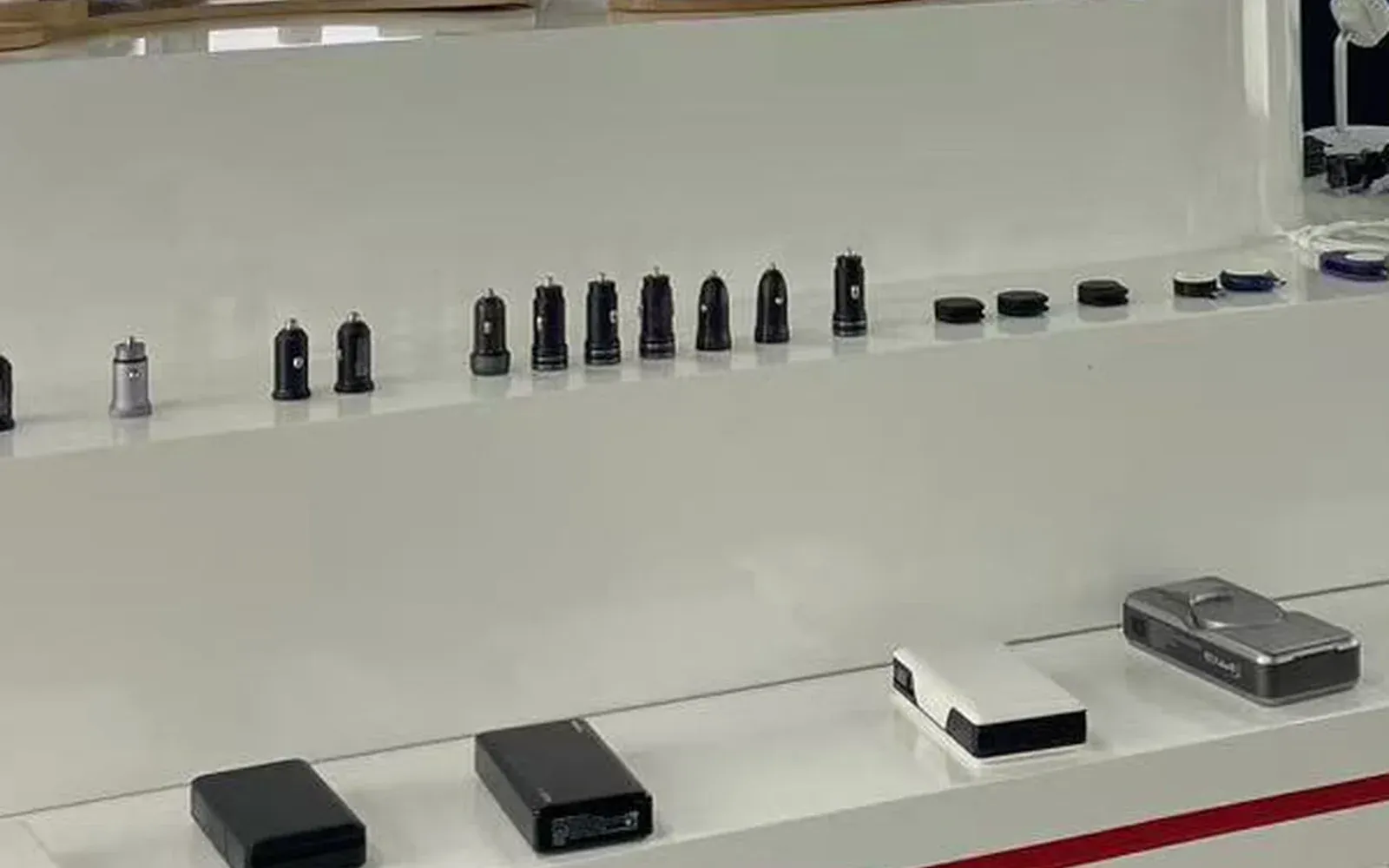
Both plants sit in Bao'an, and the second stop on the same day was eleven kilometers and half an hour from the first. The scale changed at the door. More than 800 staff. A marketing and R&D center a kilometer from the plant. The showroom came first.
That order is not an accident. A buyer is shown the surface before the machine, and the two rooms answer unrelated questions. What follows is how we read both, and what the brand authorization does and does not cover.
The Showroom Is Not the Factory
A showroom is a controlled environment. The lighting is chosen, the products sit at the right angle. That is not a criticism. A showroom is where a buyer learns the range: cables, wireless chargers, trackers, power banks, the finishes, the retail packaging and the way a logo sits on a molded part. It is a catalog you can touch.
The range is the first thing to test. A showroom that shows every cable color and one charger model is telling you where the plant's depth sits. Ask how many of those products are current, how many are samples made for a customer, and which ones the plant actually runs in volume.
What it cannot show is how the catalog gets made. Line balance, yield at the test station, the age of the equipment, the sub-tier behind a connector: none of that is on a shelf. A showroom answers what the plant can offer. The floor answers what it can repeat.
The drive between them is a useful pause. We use it to write down the questions the showroom raised, then ask them at the plant. Which line runs this product? How many units an hour? What test does every unit get? Which part of the finish is inspected by eye, and against what standard? We also ask to see the same product on the floor, not a second sample chosen for the visit.
A showroom is a stage.
Why the R&D Office Sits Apart
The marketing and R&D center sits a kilometer from the plant, and the arrangement is common at this scale. Engineering talent often prefers an office to a workshop. Most customer meetings start at the center; the floor is where the claims are tested. Prototyping, packaging design and account work happen in rooms with better light and quieter air.
The separation is not a red flag on its own. The handoff is what matters. A design that leaves the center has to survive the plant: tolerances the mold can hold, a housing that assembles without a fixture nobody owns, a test a line operator can run at pace. If the two buildings do not talk, the distance becomes a defect.
So we ask about the handoff, not the address. Who signs the transfer from design to production? Where does the pilot run happen? Who holds the fixture title, and who covers the rebuild? How does a change get versioned, and does the plant see the same drawing the center does? A separate center also means the people answering your emails may not be the people who can stop a line. Ask who holds that authority.
Ask for the change record on the last model transfer. A plant that can show one is a plant that can show you yours.
A kilometer is a short commute and a long handoff. The documents decide which one it is. The handoff is the risk.
The Lab Is the Real Scale Signal
A showroom can be assembled in a month. A lab cannot. The lab we walked through was orderly, with benches and equipment, and its own certificates were current and complete. That is a scale signal, because a lab costs capital, calibration and staff, and no plant builds one for a catalog.
For accessories, a lab of this kind earns its keep on repeatable failures. A cable bends at the strain relief until the conductor breaks. A connector goes in and out thousands of times. A charger runs hot at the coil. A power bank cycles until the cells drift. A tracker's radio has to be measured, not assumed. The point is to find those failures before a customer does, and to do it on a schedule rather than when a problem arrives.
The lab also tells you what the plant can investigate. A failure that ends in a replacement is a cost. A failure that ends in a measurement, a cause and a change is a fix.
A report from that lab is still a sample under stated conditions on a date. It is not your batch. Three questions close the gap. Was the sample pulled from production or built for the test? Which model and revision does the report name? Does the plant run routine pulls from every batch, or only when a customer asks? Add calibration dates and the signature on the report, and the lab becomes a fact rather than a feature.
A lab is capital.
What Brand Authorization Does and Does Not Cover
The phrase licensed manufacturer sounds like a grade. It is a permission, and permissions have edges. A brand authorization is a contract that lets a company make and sell certain products under certain marks, in certain places, for a certain period. It usually names the categories, the models, the territory, the term and the obligations: how the logo is used, how the packaging is approved, what testing is required, what audit access the brand keeps.
What it covers is narrower than most buyers assume. It covers the products named in the file, not the whole catalog. It usually names a site, and subcontracting needs to be allowed in writing. It does not cover your brand, your design or your market unless those are written in. It does not make the product good. It makes the product permissible within a scope.
A licensed program usually comes with obligations that reach into the plant: logo approval, packaging approval, testing, audit access. That reach is a signal from a demanding customer, not a warranty for your order.
The license also says who is responsible after a recall or a claim. Read the recall and indemnity clauses, and ask whether the plant carries product liability cover for the categories you are buying. A permission to manufacture is not a promise to stand behind the goods.
So we read the file as a scope document, not a trophy. Find the product list, the territory, the expiry date and the audit clause. Check who holds the license, and whether the site you visited is named in it. Then ask the question that decides the file's usefulness. Does this authorization cover the exact model I am buying, made at this plant, for the market I am selling into?
Two lines carry the same weight as the scope. The expiry date tells you whether the file outlives your order, and the territory sets where the license applies. A license for one region does not travel with the goods.
A license has edges.
The Product Lines and the Failure Points
Four product families, with magnetic charging as a variant, four different ways to fail. A cable fails at the ends: the strain relief, the solder joint, the plating on the connector. The questions are conductor gauge, strand count, bend life and how the plug is molded to the jacket. A sample that survives a pull by hand proves almost nothing.
A wireless charger fails at the coil and the heat. Alignment decides whether the phone charges at all, and heat decides for how long. Ask how the coil is positioned, what the unit does when a metal object lands on the pad, and how the surface holds up after repeated cycles. Magnetic alignment makes the user's job easier. It does not prove the coil is centered or the heat is managed.
The test that matters for a charger is not a five-minute charge on a desk. It is a full cycle at the worst case, with the phone in a case and the room warm, repeated on units from the line.
A tracker fails at the radio and the battery. Antenna placement inside a small housing is a compromise, and a pairing that works on a bench may fail in a bag. We ask for the range test, the battery life under a stated use pattern, and the privacy of the data path.
A power bank fails at the cell. Capacity claims are easy to print and hard to verify, protection boards vary, and heat is the tell. Ask which cell family is used, whether cells are matched, what the protection board does, and how the pack travels under transport rules. A capacity number without a test condition is a slogan.
The lines share a floor, not a failure mode. Every line has a weak point.
What to Verify in a Licensed Supplier
We start with the scope line. The authorization should name the product category and the models, and your SKU should sit inside it. Check the expiry date, the territory and whether the licensed site is the one you visited. A license held by a trading arm differs from one held by the plant.
Then the paper behind the product. A lab report should name the model, the revision and the test conditions, and the sample should come from production. Ask whether routine pulls happen per batch. Ask who signs the report and when the equipment was last calibrated.
Then the build route. Which line is booked for your SKU, what else shares that line, and what changes at the changeover. Ask for the process flow, and find the station where your product could fail. For a cable, that is the molding and the bend test. For a charger, it is the coil placement and the thermal soak. For a power bank, it is cell matching and the protection board test. Ask whether every unit is tested or only a sample.
Then the commercial edges. Who owns the tooling, who approves the packaging and the logo, who carries a recall, and what the brand's audit clause lets you see. Ask whether any step is subcontracted, and get the answer in writing. A licensed plant can still buy a sub-assembly from a supplier you have never seen.
Ask who signs the conformity document for your shipment, and who can stop the line. If they are the same person, the plant is small in a way the headcount hides.
Last, capacity. More than 800 staff is a headline. The line assigned to your order is the fact. Ask for the booking, the daily output, and the plan if a component runs late.
Check the scope line first.
Send the Product Spec and the Authorization
Send the product spec and the authorization you need checked (/contact-us). Our check reads the license against the spec: the category, the models, the territory, the term and the site. Then we read the plant against both, and name what the file covers and what needs a separate approval.
On a visit, we ask the same questions on the floor. A visit should test the scope, not repeat the pitch. That is where the file meets the line. Our B2B accounts open at USD 10,000 of spend a year. The checks, from the first record to the loaded carton, are set out in the sourcing notes (/b2b-sourcing). A licensed plant is a strong start. The scope is what makes it usable.
Dore Technology Co., Ltd. remains the contracting party.