Oct 28, 2026Sourcing Guides
Shopify Fulfillment vs US 3PL: The Break-Even Profile
A rate card compares warehouses. A break-even profile compares inventory positions. The five lines, three variables and two runs that show which model fits your orders.
A Shopify store ships its first orders from a China warehouse and later adds a US 3PL, or does the reverse. The decision looks like a price comparison and behaves like a location decision. Two inventory positions, two delivery promises, two cash curves. The order count alone does not settle it. Our team handles China-based fulfillment for stores that ship five orders per day or more, and this is the profile we build before a warehouse choice. There is no universal break-even order count. There is a break-even profile, and yours has a shape. A warehouse is not a rate line. It is a position on the map, and the map decides which costs sit where. The same store can be a good fit for one model this year and the other model next year. The profile changes. The structure does not.
The Comparison Is Not a Rate Card
A rate card prices a warehouse's work. It leaves the inventory question open. A China fulfillment model and a US 3PL sell different journeys: one parcel crosses a border, the other starts inside the destination market. The same pick-and-pack action appears in both, and it carries different weight in each.
The comparison that matters is structural. Where does the stock sit? Who owns the first leg? Which promise can the store make? When does the cash leave? A rate sheet answers none of those questions on its own.
We start with the order profile, not the rate sheet. The profile decides which lines carry weight, and the lines decide the break-even. A store with light parcels and a tolerant promise will see one shape. A store with heavy parcels and a tight expectation will see another.
The break-even is a point on a curve, not a number on a card. Two stores with the same daily order count can land on opposite sides of it. Location first. Rate second. That is why we refuse to quote a single threshold. The threshold moves with the parcel and the postcode.
What China Fulfillment Bundles
A China fulfillment model keeps stock close to the factory base. The warehouse receives cartons from several suppliers, checks them on arrival, holds them, and ships each order across the border to the buyer. The bundle usually includes consolidation, inbound inspection, storage and the outbound international move.
Consolidation gathers cartons from more than one factory into one warehouse before the export move, so the store does not pay for several separate export flows. Inbound inspection checks every unit in the delivery before any of it can be sold. Storage starts with seven days free, which gives a new delivery time to clear before storage starts to bill. FBA prep handles the labeling and carton work for stock going to a marketplace.
The outbound leg is where the model shows its shape. Each parcel crosses a customs boundary, so the transit is longer and the promise has to be written around it. The returns path is longer too. A returned unit travels back across the border or waits for a decision abroad. Returns that reach the China warehouse are sorted into A, B and C grades; each unit is then either repacked for relisting or photographed and held for your decision.
This model suits light, small, long-shelf-life products with a customer who accepts a longer window. It also suits a store that keeps several suppliers and wants one receiving point. It does not suit every order, and it is not automatically cheaper. The inventory stays close to the source. That is the structural bet. For a slow-moving catalogue, the China position keeps cash closer to the next production run, because the stock has not crossed an ocean to wait. The floor work behind the bundle, from inbound inspection to dispatch, is described on the fulfillment overview (/b2c-fulfillment).
What a US 3PL Bundles
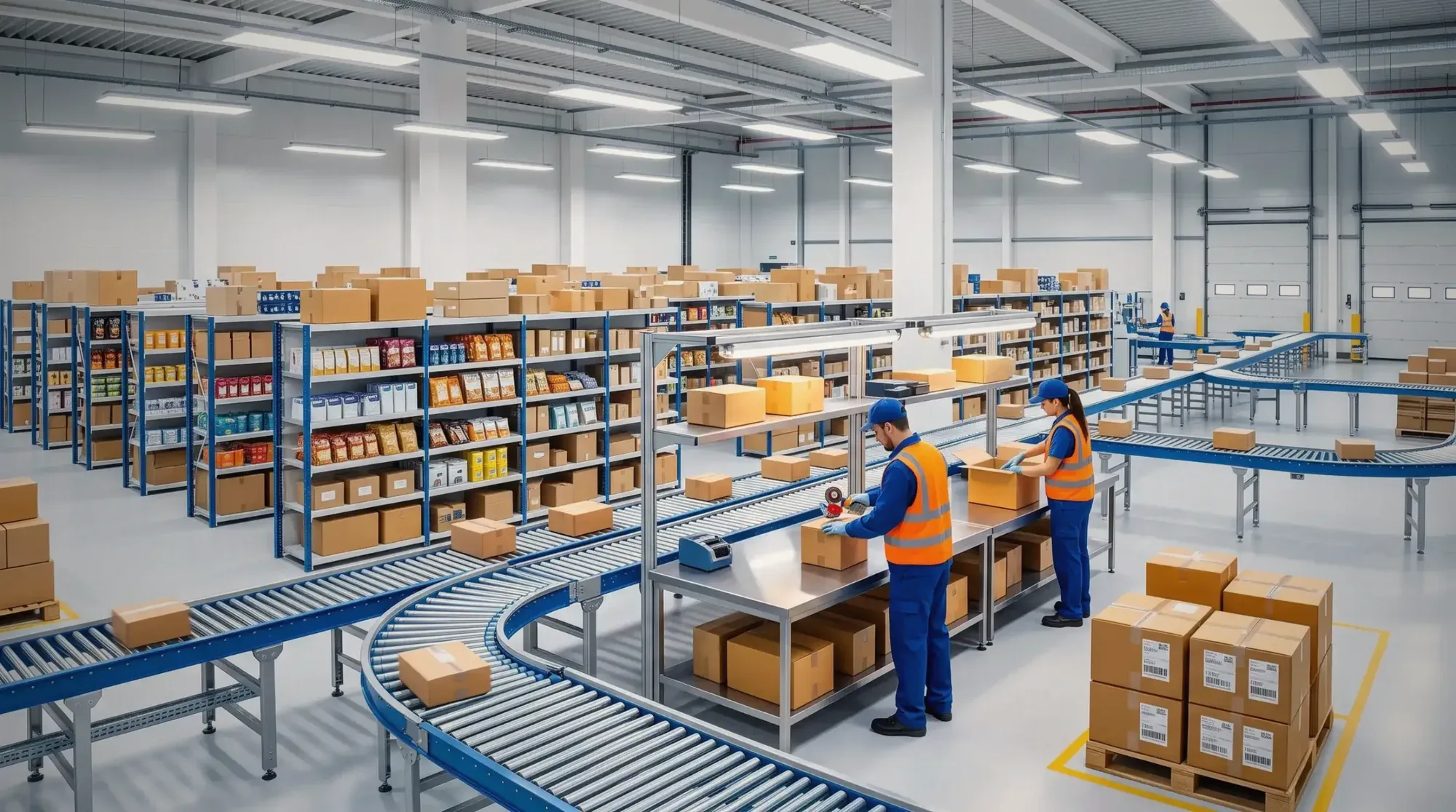
A US 3PL moves the inventory decision closer to the buyer. Stock crosses the border in bulk first, clears entry, and sits in a warehouse inside the destination market. From there, each order is picked, packed and delivered on a domestic leg.
The bundle covers the inbound move into the US warehouse, space, order handling, the domestic last mile and a domestic returns address. The first leg is a bulk move, not a parcel flow. That changes the cash profile: the store commits inventory earlier and in larger blocks.
The domestic leg is the structural advantage. A US warehouse can shorten the last mile, and it can support a shorter delivery promise than a typical cross-border parcel. It cannot shorten the first mile. The stock still has to reach the US before any of that speed is available.
That trade is the whole model. Speed near the buyer is bought with inventory far from the factory and with a larger position at risk. Heavy or bulky goods often tilt toward this side because the international parcel cost on each order is high. Time-sensitive orders tilt the same way.
A US 3PL is a category, not a brand. The operating quality varies, and the bundle above is the structure to compare, not a promise about any one provider. Proximity has a price. The first leg is easy to underestimate. For a heavy SKU, the parcel math changes before the warehouse math does. We keep the comparison at that level.
The Five Lines That Decide the Break-Even
Five lines carry the comparison. Each one behaves differently depending on where the stock sits.
The first is landed inbound: the freight that brings stock to the warehouse plus the duty and entry work attached to it. In a China model, that cost is incurred at the outbound parcel, because each order crosses the border; the parcel terms decide who pays it. In a US model, it sits on the bulk inbound and is spread across the orders that follow. Same product, different moment of payment.
The second is space. Both models charge for the shelf, and what matters is what the shelf holds. A China warehouse holds the long tail close to the supplier. A US warehouse holds the fast movers close to the buyer. Slow stock in the wrong place pays for a position it cannot earn back.
The third is order handling: pick, pack, materials and the labor around them. The work is similar in both models. The difference is the paperwork and the parcel spec that surround it, because one order leaves the country and the other does not.
The fourth is last mile. A domestic leg is structurally shorter. A cross-border leg is structurally longer. Neither is free, and neither is always the right answer. The promise the store makes decides how much this line is worth.
The fifth is returns and cash. A domestic return comes back to a nearby address. A cross-border return has a longer path, or it stops at a local decision point. Cash follows the same geometry: US stock is committed earlier; China stock stays closer to replenishment.
We read the five lines together. One line can favor one model while the other four pull the other way. The total is the only number that matters.
Volume, Weight and Destination: The Three Variables
Three variables move the break-even, and none of them is the order count on its own.
Volume is the first. Daily order count matters, but density can matter more. A dense run of orders into one coast is a different operation from the same total spread across four regions. Density decides how often a pickup fills and how predictable the outbound line becomes.
Weight and size are the second. A light parcel and a heavy parcel do not cross a border at the same cost, and the gap widens as the packed volume grows. A product that ships in a small mailer can live comfortably in a China model. A product that ships in a large carton often tilts toward a US position, because the international leg is priced on the space it takes.
Destination is the third. A single-market store has one promise to design. A store selling into several countries has several customs paths, several last-mile structures and several return routes. The more spread the destinations, the more the model has to be built around the edges rather than the average.
The three variables interact. A light, dense, single-market catalogue can break even at a modest volume. A heavy, bulky, multi-market catalogue may need a US position before the order count looks impressive. Volume without density is a busy month, not a scale advantage. We test the variables together, never one at a time. That is why a universal break-even order count does not exist. The profile decides.
Run the Break-Even on Your Order Profile
Start with six inputs on a single sheet: SKU count, daily order average, average parcel weight and packed size, destination mix, return rate and the delivery promise you make. Those six inputs describe the order profile. The five lines sit underneath.
Run the profile twice. Once on the month you are in and once on your quietest month. The second run shows which of the five lines keep their weight when orders fall away. A strong month can hide a position that a quiet month cannot carry.
Then read the delivery promise as a line of its own. A shorter promise can win orders and cost money at the same time. A longer promise can protect margin and lose the customer who needed the parcel this week. The promise is not a slogan. It is a decision with a cost attached.
Mark how each line behaves against the two runs. Ask which lines fall with order volume and which stay near the same number. That answer tells you which model carries more of the cost when trade slows, and it tells you where a small change in the profile can move the break-even.
We build this on your numbers, not on an average store. A model built on averages answers a question nobody asked. The profile is the only input that makes the arithmetic useful. The math is easy. The inputs are not. A quiet month is not a hypothetical; it belongs to the year. Put the two runs side by side and read the gap.
Send the Profile Before You Switch
Send the order profile before you choose the warehouse (/contact-us). Add the cost data you already have, if any, and the delivery promise you want to keep. We return a break-even table built on the five lines and your profile, with the assumptions marked.
The table does not pick a winner for you. It shows where each model carries more weight, which line moves first when volume changes, and which input would have to be true for the other side to win. A break-even built on your numbers can be argued with. A threshold pulled from an article cannot.
Bring the quiet month too. A table built only on the best month is a sales document. If the store has never shipped from a China warehouse, say so. The first profile is usually the least accurate one, and the assumptions matter more than the total. We would rather mark an assumption than hide it.
Dore Technology Co., Ltd. holds the contract. Our work starts with stores that ship five orders per day or more. Two models, one profile. The profile decides.