Aug 14, 2026Sourcing Guides
Source Motorcycle Top Boxes from China: OEM/ODM Guide
Compare motorcycle top box materials, mounting systems, suppliers, customization, and quality controls before placing an OEM or ODM order in China.
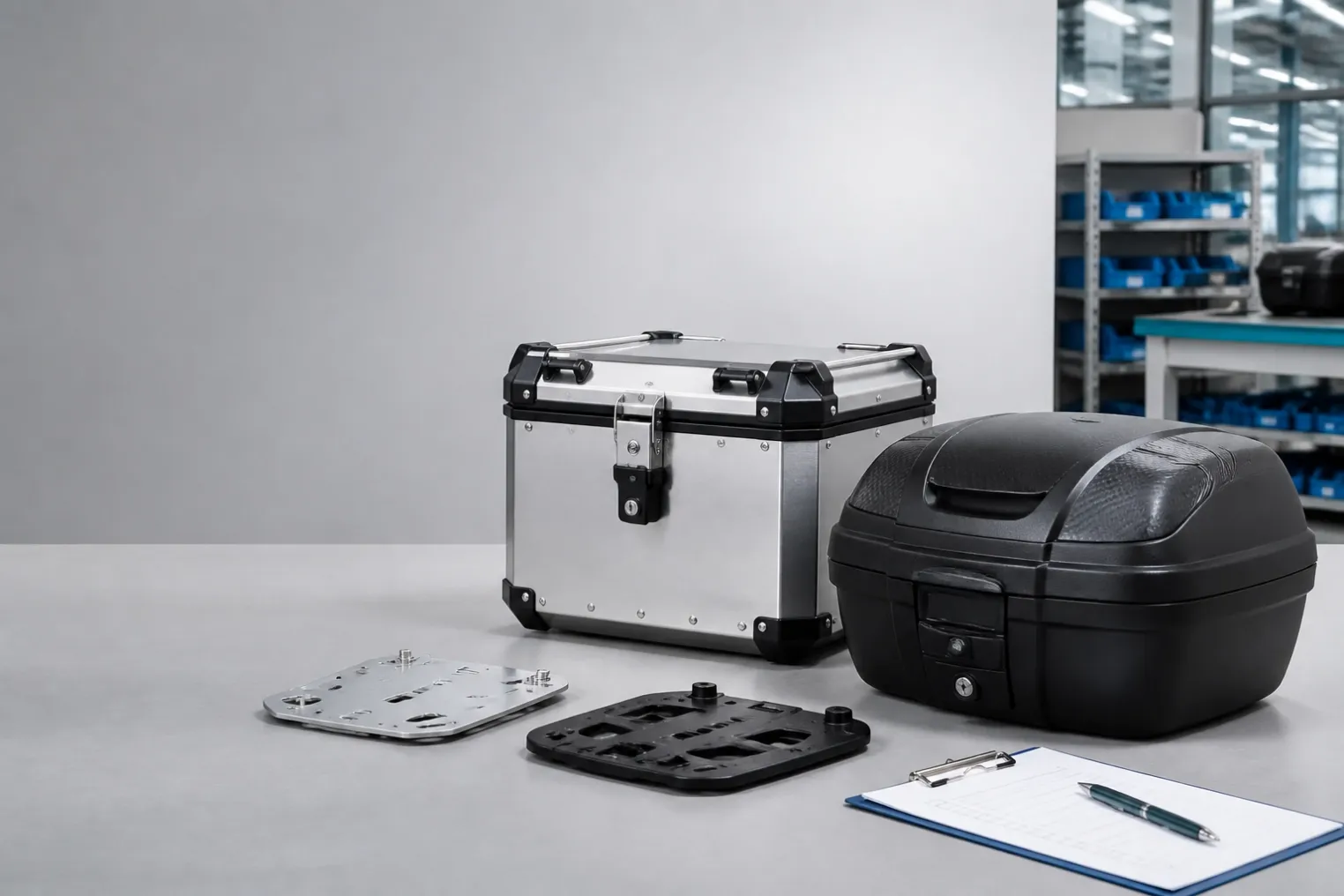
Sourcing a motorcycle top box is not simply a matter of choosing a size and comparing prices. The shell, lock, hinges, seals, mounting plate, fasteners, packaging, and replacement parts must work as one system.
This guide gives importers and distributors a practical framework for preparing an RFQ, comparing suppliers, approving samples, and defining quality checks for OEM and ODM motorcycle luggage programs.
Key sourcing decisions at a glance
Match the shell material to the target rider, retail price, and operating environment.
Specify fit and load separately: usable internal dimensions, rated load, and helmet fit are different requirements.
Treat the mounting system as safety-critical: review the plate, latch, adapters, and fasteners together.
Approve before production: lock a functional sample and inspection checklist before mass production.
1. Start with a technical buying brief
Before requesting quotations, define the intended use: daily commuting, delivery fleets, touring, or adventure riding. Add the target retail tier, destination market, expected order quantity, and motorcycle or rack interfaces that the product must support.
A shared brief gives every supplier the same commercial and technical target. It also reduces the risk of comparing quotations based on different materials, accessories, packaging, or test assumptions.
2. Select the right shell material
Polypropylene for value-oriented programs
Polypropylene is commonly used for commuter and scooter top boxes because it can be lightweight, impact-tolerant, and economical at volume. Buyers should still confirm the resin grade, wall design, reinforcement points, and permitted recycled-content level.
ABS for a rigid, finished appearance
ABS can support a rigid shell and painted surface, but performance depends on the grade, thickness, structural design, and impact requirements. The material name alone is not a sufficient specification.
Aluminum for touring and adventure positioning
Aluminum cases are often positioned for touring and adventure use. Specify the alloy, panel thickness, corner construction, surface treatment, gasket material, and corrosion protection for locks and fasteners.
3. Define capacity, load, and helmet fit separately
Two products with the same claimed capacity can have different usable interiors because of lid geometry, hinge intrusion, and lock housings. Request internal dimensions and test the actual helmet or cargo types the product is expected to carry.
Target internal volume and usable dimensions
Maximum recommended load and test method
Single-helmet, dual-helmet, parcel, or touring-luggage requirement
Included mounting plate, adapters, and fasteners
4. Evaluate the mounting system
The base plate, latch, and rack adapters receive repeated vibration and shock loads. Ask for drawings or clear measurements of the interface, fastener grade, reinforcement points, and supplied hardware.
Install the sample on a representative rack. Check movement, seat and light clearance, ease of removal, key operation, and accidental-release risk. If a product is described as universal, document the supported rack dimensions and all exclusions.
5. Separate customization from new product development
Logo application, labels, colors, cartons, and interior accessories may be available on an existing product platform. Changes to shell geometry, capacity, mounting mechanisms, or structural parts may require engineering work, prototypes, and new tooling.
Ask the supplier to separate existing-tool customization, component changes, and new tooling in the quotation. Confirm the minimum order quantity, sample cost, tooling ownership, packaging specification, and production lead time in writing.
6. Verify the supplier behind the listing
A marketplace listing does not prove that a company manufactures the product. Verify the legal entity, business scope, production address, relevant processes, quality records, and control of subcontracted work.
When an on-site review is possible, look for the processes the supplier claims to perform, along with assembly, incoming inspection, finished-goods inspection, functional testing, and packaging. Photos and videos should be connected to the supplier, date, and product under review.
7. Build quality controls before production
The inspection plan should be agreed before production begins. Use an approved sample and specification sheet as the benchmark, then define the test method and acceptance limit for each checkpoint.
Material, color, dimensions, weight, and surface finish
Lock, latch, hinge, and quick-release operation
Gasket continuity and agreed water-resistance check
Stress areas around mounting points and fasteners
Mounting kit, keys, instructions, labels, and carton marks
Do not copy a certification or test claim from another supplier. Request the underlying document, model coverage, and issuing body, and obtain qualified compliance advice when destination-market rules apply.
8. Adapt the offer for Latin American distribution
Latin American distributors may need products for commuter motorcycles, delivery work, and price-sensitive aftermarket channels. Evaluate rain and ultraviolet exposure, availability of replacement locks and mounting plates, Spanish or Portuguese instructions, and the ability to consolidate mixed models.
A focused assortment can be easier to sell and support than many similar models. Consider a compact commuter box, a mid-capacity helmet box, and a larger touring or adventure option, then confirm local rack patterns with distributors before finalizing the range.
A five-step sourcing workflow
Prepare one RFQ covering application, material, capacity, mounting, customization, packaging, and testing.
Shortlist suppliers using both commercial fit and verified manufacturing capability.
Compare quotations on the same assumptions, including tooling and accessories.
Approve a functional sample and lock the specification and inspection checklist.
Monitor production and inspect the finished shipment against the approved benchmark.
Frequently asked questions
What should a motorcycle top box RFQ include?
Include the target motorcycle types, shell material, usable capacity, rated load, mounting interface, lock and hardware requirements, branding, packaging, destination market, estimated quantity, and delivery schedule.
Is an aluminum top box always better than a plastic one?
No. The right material depends on price positioning, weight, appearance, operating conditions, intended motorcycle, and customer expectations. Construction quality and mounting design are equally important.
Can an importer start with an existing mold?
Often yes. An existing platform can reduce development time when its capacity, mounting system, and structure fit the market. Confirm the available branding, color, packaging, and minimum-order options with the selected supplier.
When should quality inspection take place?
Quality planning begins with sample approval. Depending on supplier risk and order size, buyers may add early-production or in-process checks before the final pre-shipment inspection.
Related B&C Sourcify resources
Explore our B2B sourcing service in China for supplier screening, factory coordination, and quality-control support.
How B&C Sourcify supports an aluminum top-box program
B&C Sourcify has conducted an on-site review of an aluminum motorcycle top-box factory with competitive products, responsive cooperation, and customization capability.
Factory coordination: communicate customization, samples, packaging, and production requirements with the supplier.
On-site execution: support factory follow-up, quality checks, and container-loading coordination in China.
Consolidated sourcing: combine compatible products from other suppliers, such as emergency LED lights, with the motorcycle luggage shipment when the packing plan allows.
Freight-space efficiency: evaluate whether smaller products can be packed inside suitable top boxes to reduce unused volume and improve container utilization.
The final packing method must be confirmed against product protection, carton markings, customs documentation, and destination-market requirements before shipment.
Request a motorcycle luggage sourcing review
B&C Sourcify can help importers prepare a factory RFQ, compare suppliers, coordinate samples, and document on-site quality checks.
Request an initial sourcing review by sending your target market, capacity range, material preference, branding requirements, and estimated order quantity.