
Aug 25, 2026Sourcing Guides
Private Label Bluetooth Speakers: First-Order Checklist
Plan a controlled private-label Bluetooth speaker first order with packaging, localization, Golden Sample, QC, and scaling steps for emerging markets.
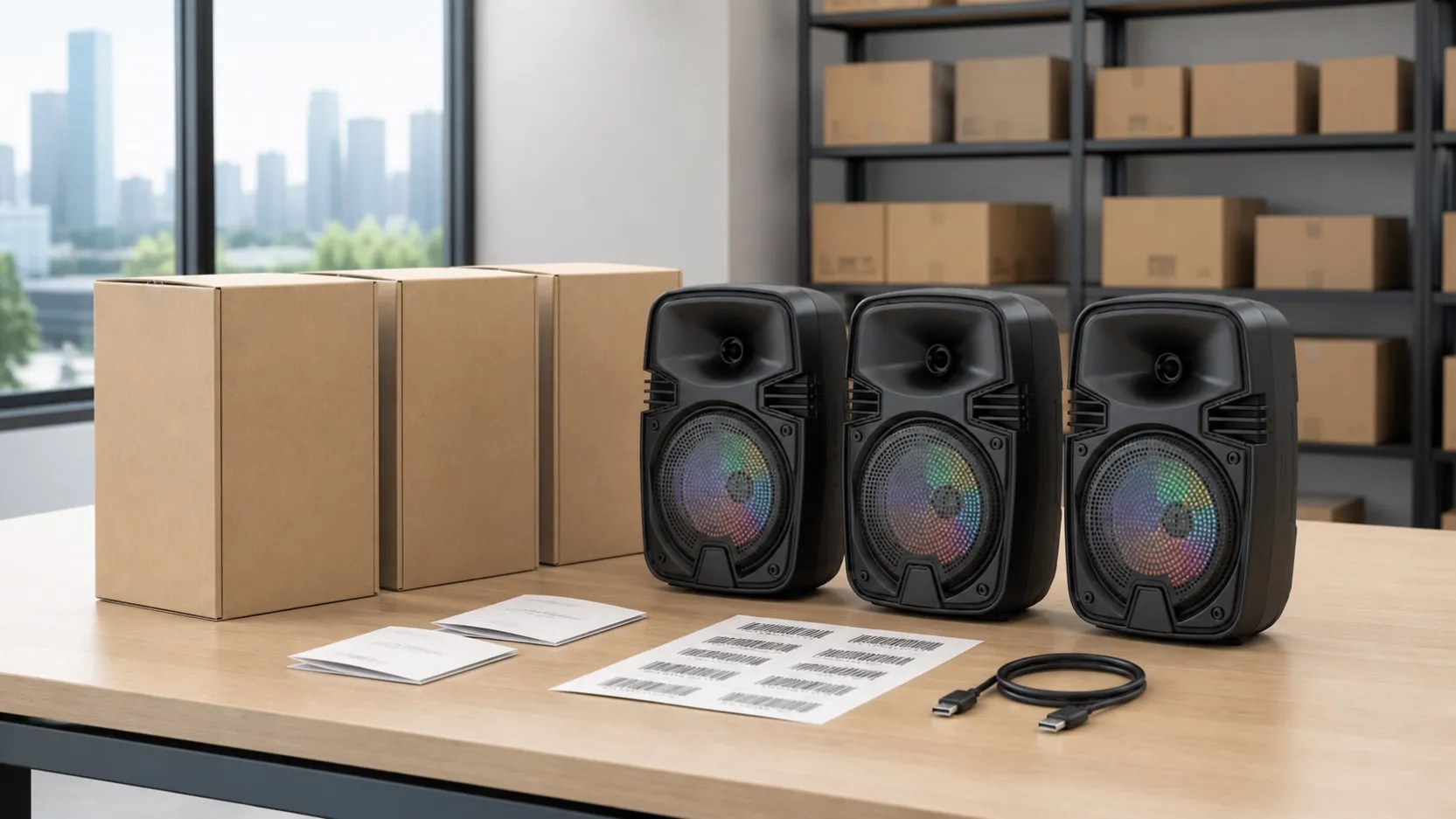
A private-label portable speaker program can fail before production begins. The usual causes are incomplete artwork, unclear language requirements, mismatched accessories, untested packaging, and a first order that is too broad for the sales channel.
This checklist helps importers, distributors, wholesalers, and regional e-commerce brands prepare a controlled first order from China for Latin America, the Middle East, and other Belt and Road markets.
Separate the first-order decision from the long-term product line
The first purchase order should validate the product, packaging, market response, supplier execution, and logistics process. It does not need to include every color, function, or accessory planned for the future.
Select one or two models with a clear customer and price position.
Limit colors and packaging variations until demand is proven.
Define the destination country, sales channel, order quantity, and launch date.
Record which decisions are fixed for the first order and which can change later.
For buyers still comparing models, review our portable Bluetooth speaker sourcing guide before confirming the first-order shortlist.
Use a value-focused Hero Product as the starting point
B&C currently has access to a compact black 4-inch speaker with Bluetooth, TF card, USB, FM radio, RGB lighting, a 500 mAh lithium battery, and Type-C charging. The supplier-provided reference ex-factory price is US$9.99 per unit for the discussed configuration, and the factory reports shipping more than 500,000 sets during the first half of 2026.
The price and shipment figure are commercial reference information rather than a permanent quotation or independently audited claim. Final pricing depends on quantity, branding, packaging, components, payment terms, and delivery schedule. A physical sample and current written quotation are required before ordering.
This model is useful as a first-order candidate because it concentrates on basic functions rather than an expensive feature set. The sourcing task is to confirm whether its performance and presentation match the buyer's channel.
Lock the product configuration before artwork
Artwork should not start while the product specification is still changing. First confirm the model, housing color, functions, battery, charging cable, controls, accessories, and standard packaging structure.
Product confirmation checklist
Model number, product dimensions, color, and approved sample revision.
Bluetooth, TF card, USB, FM radio, lighting, and other required functions.
Battery specification, charging input, cable type, and agreed runtime test.
Included accessories and any items excluded from the quotation.
Logo location, application method, size, and approved color reference.
Prepare market-specific packaging and language files
Latin America and the Middle East are not single-language markets. Packaging, manuals, labels, voice prompts, warnings, and customer-support information should be planned for the exact destination and channel.
Spanish and Portuguese programs
Confirm whether the product is intended for Spanish-speaking markets, Brazil, or a mixed regional program. Do not reuse machine-translated instructions without review by a fluent market specialist.
Arabic and bilingual programs
Arabic layout requires attention to right-to-left text, font support, line breaks, and the relationship between Arabic and English copy. Ask the local importer to approve the final files before printing.
What should appear in the artwork pack?
Brand files, logo colors, model name, and product images.
Approved feature statements and accessory list.
Manual copy, warnings, importer information, and customer-service details supplied by the buyer.
Barcode type, barcode data, label position, and carton marks.
Country-specific information confirmed by the importer or qualified adviser.
Do not print compliance claims before verification
A supplier may provide reports or certificates, but buyers must confirm that each document covers the exact product model, configuration, components, destination requirement, and current production.
Do not copy a mark from another model, a catalogue image, or an unrelated certificate. Battery, radio, electrical, labeling, environmental, and transport requirements differ by destination and selling method. B&C can collect supplier documents and coordinate questions, while the importer or qualified local adviser confirms market applicability.
Approve a packaging sample, not only a product sample
A working speaker can still arrive with crushed cartons, scratched housings, loose accessories, or incorrect labels. Request a complete packaging sample with the final product, cable, inserts, manual, retail box, labels, and export carton.
Check fit: the speaker and accessories should not move excessively inside the retail pack.
Check protection: corners, grille, handle, controls, and charging port need suitable protection.
Check information: model, color, barcode, accessories, language, and carton marks must match the order.
Check logistics data: confirm units per carton, carton dimensions, gross weight, and loading assumptions.
Check appearance: printed colors, image quality, finish, and label placement should match approved files.
Build a Golden Sample and inspection checklist
The approved Golden Sample should represent the product and packaging the factory must reproduce. Record its revision and connect it to the purchase order, specification, artwork, and inspection checklist.
Pre-shipment checks can cover appearance, logo, Bluetooth pairing, controls, FM and media functions, lighting, charging, speaker output comparison, accessories, labels, retail packaging, quantities, and export cartons. Test conditions and acceptance limits must be agreed before production finishes.
B&C Sourcify can coordinate supplier communication, sampling, production follow-up, inspection, packaging review, warehousing, and loading according to the agreed scope. Learn more about our China B2B sourcing service.
Plan a first order that can scale
A controlled first order should create reusable assets: approved artwork, a Golden Sample, a specification sheet, inspection criteria, packing data, supplier contacts, and a record of corrective actions.
After the first shipment, review defects, returns, sell-through, customer feedback, packaging damage, and actual logistics cost. Use that evidence to decide whether to reorder, add colors, introduce a larger model, or expand into related electronics.
Use Cross-Sourcing for the same customer channel
Once the speaker program is stable, the importer may add compatible products such as LED lighting, cameras, charging accessories, outdoor electronics, or promotional packaging. B&C can coordinate multiple suppliers, receive goods, check quantities and packaging, and prepare a consolidated shipment when the product mix supports it.
Consolidation does not guarantee a fixed saving. The result depends on quantities, carton dimensions, supplier locations, shipping mode, protection, and destination requirements.
Frequently asked questions
Can we add our logo to an existing speaker model?
Often yes. The available process, logo size, color, position, minimum quantity, sample timing, and durability should be confirmed with the selected supplier.
Should the first order use custom retail packaging?
It depends on the channel and minimum quantity. Custom packaging can strengthen presentation, but it adds artwork, proofing, printing, and inventory risk. A label or sleeve may be a practical first-order alternative when approved by the buyer.
Who should approve translations?
The importer should arrange approval by a fluent market specialist familiar with the product and destination. The factory should not make unapproved language changes during printing.
When should inspection criteria be confirmed?
Before mass production. The approved sample, specification, artwork, and test methods should be ready before the final inspection is scheduled.
Prepare your private-label speaker first order
Request a first-order review from B&C Sourcify. Send your destination country, customer type, target quantity, selected model, required languages, branding files, packaging plan, and launch date. We will identify the confirmed facts, missing supplier inputs, and practical next steps.