Oct 16, 2026Sourcing Guides
How to Source Commercial and Industrial LED Lighting from China: A Buyer's Engineering Guide
Two 100W fixtures can be two different products. The engineering decisions that separate them, from the aluminum to the paperwork, and how to read them before you compare quotes.
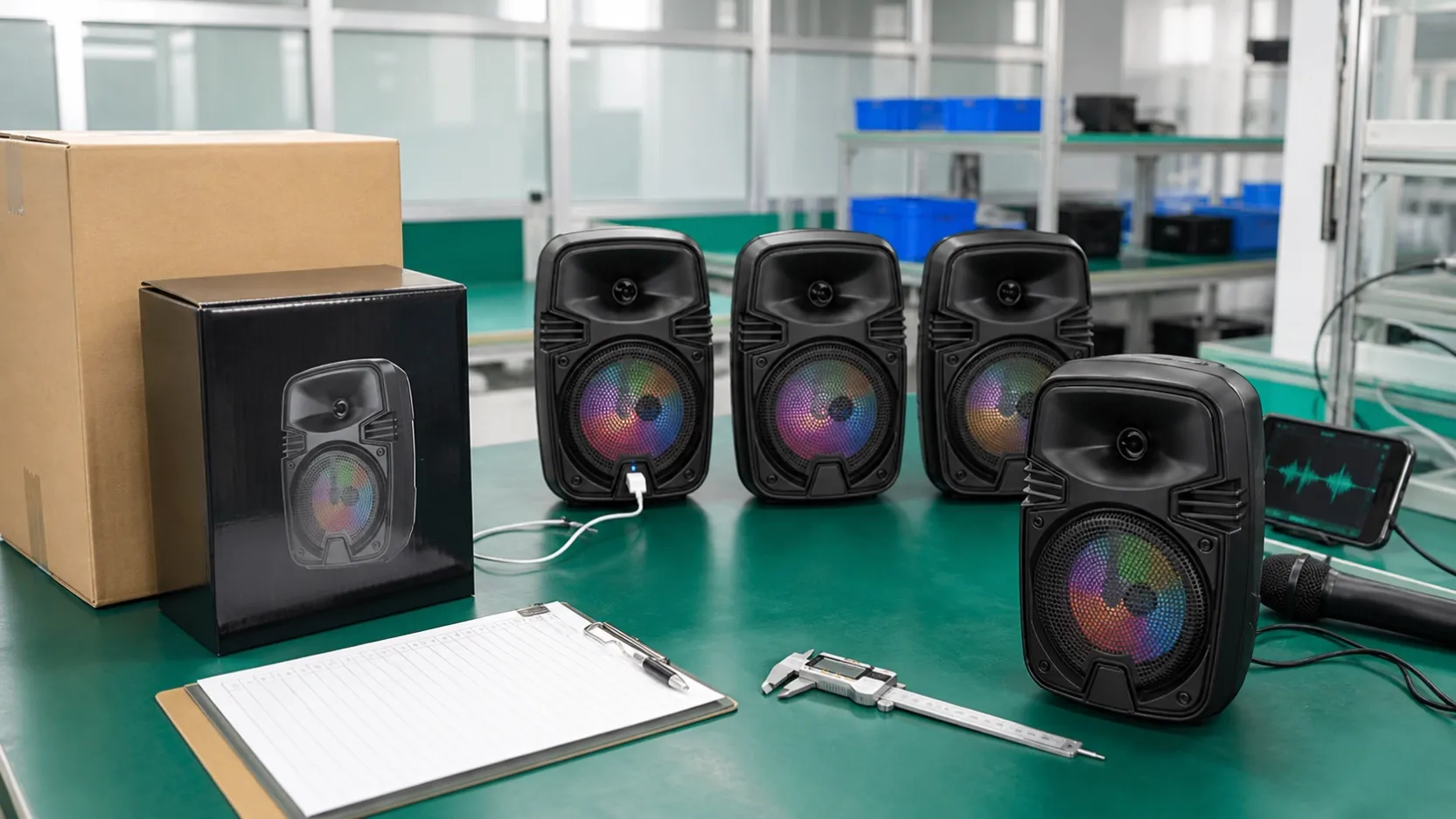
Two fixtures carry the same 100W label. One sells for half of the other, and neither number is a lie. The gap sits inside the product: the aluminum, the thermal path, the optics, the driver, the compliance file. We source commercial and industrial lighting out of Shenzhen, backed by a family sheet metal factory. This is the sequence we would run if the purchase were ours.
Start With the Environment, Not the Price List
The environment makes the first cut, long before anyone opens a price list. A warehouse ceiling, a coastal yard, a humid food plant and a loading dock demand different builds, and the differences live in housing, sealing, optics and mounts. So we sort lighting into three working groups before quoting. Outdoor and industrial fixtures, floodlights from 10W to 1000W and high bays from 50W to 400W among them; indoor and commercial lines; specialty builds, where the application sets the rules. Mounting height and weather decide the group; the wattage label decides almost nothing alone.
The full line we work with, outdoor, indoor and specialty, sits on our LED lighting page (/industry/led-lighting-indoor-outdoor-industrial).
What a Factory Sees in a Luminaire: Housing, Thermal Path and Optics
A quote says aluminum housing and stops there; our questions start in that gap. We ask how the aluminum was formed, because an extrusion and a die-casting carry different tooling and different heat behavior. Wall gauge, fin geometry, and the air the fins leave around the driver cavity decide how warm the electronics run by year three. Brightness on day one is the easy number; heat over time is the expensive one.
Then the plastic parts: end caps and diffusers. Those come out of injection molds, so we read the tool steel and approve the first shot before volume runs, because a mold that runs clean on the first shot runs clean all year. Custom builds reopen these questions, tooling, optics, drivers, not a logo print. Our OEM/ODM guide maps the longer road, drawing to mass production.
Optics are the third read. A lens or a reflector decides where the light lands, and the beam angle must match the mounting height and the work below it. Same wattage, same yard, completely different light. Geometry, not marketing.
The Driver Decides Whether the Spec Survives Year Two
When a fixture fails early, the driver is usually the reason. We treat it as the part that decides whether a spec survives year two, so it gets chosen like a component. The factories we work with build around Mean Well and SOSEN drivers, and keep in-house boards as a third option.
Two decisions get locked early. Constant current or constant voltage, which follows the fixture form, because panels and strips do not want the same feed. And the dimming protocol, which must match the control system already on site. 0-10V, DALI and Triac are all in play, and swapping protocol after the driver is locked reopens the design. A driver problem does not stay a driver problem; it becomes your after-sales file.
CCT, CRI, Beam Angle: Specify by Application, Not by Habit
Color temperature and color rendering are application decisions, not defaults. A fitting room or a photo studio needs CRI 90 and above; a warehouse aisle rarely does. The line customizes CCT from 2700 to 6500K and CRI at 80, 90 or 95 plus; specialty builds hold fixed wavelengths, red-light therapy panels at 630 to 660nm and 810 to 850nm among them.
The real risk is the reorder. Not the first order. Tint drift between batches lands in your showroom, not on a spec sheet, so lock the CCT bin and CRI target at order placement, and agree what sample settles a dispute. Beam angle follows suit: match it to the mounting height and the surface, not the last project's habit.
IP Ratings and the Weather You Actually Face
Protection ratings get sold like grades. Buyers ask for the highest number and move on. Sealing a fixture harder than its job needs costs light output and heat headroom; a covered dock, a coastal yard and a washdown zone face different weather.
Start from what the fixture will actually meet: rain at an angle, hose water, dust, condensation on a cold morning. Sealing lives in the details, the gasket line, the cable entry, the glue path at the lens edge, and those are the parts we pull and look at on samples. The factories sample-verify the protection claim on every batch; the buyer's job is to fix what gets checked and which reports follow the goods. Pick the rating the site needs.
Lock the Compliance File Before You Talk Price
Certification is a file question before it is a technical one. The fixtures we work with carry UL and cUL, DLC, CE, RoHS, EMC, SAA and TUV listings, and none of it matters until the listing maps to the exact unit you ordered. Pin down three things before the price talk.
Which configuration carries the mark, down to the driver and dimming option, because a variant of the listed model can fall outside the file. Which market the shipment is bound for, and what that market's channels will ask to see. And how the paper rides with the shipment, not after it. We match configuration, market and file on every order, with the factories' test data beside it. Done early, this is an afternoon of admin. Done late, it is stuck freight.
Reading a Quote and Checking the Goods: The Buyer's Short Checklist
Two quotes, same look on paper, far apart on price. Four fields explain the gap, and the factory's profit margin is not one of them: aluminum, driver and dimming, optics, certification coverage. When a number comes in low, ask three questions.
Which housing is this, extrusion or die-cast, and how does it shed heat?
Which driver and dimming are quoted, and is the certified build the one in this price?
Which lens or reflector is fitted, and at what beam angle?
Then agree the checks: seal one golden sample ahead of the run, compare production against it, and stand at the factory on loading day. Packing joins the conversation; a custom housing has no standard carton. Minimums with the factories we work with typically run 200 to 500 pcs, and production takes 20 to 40 days. On one container load, small lighting items rode in the dead corners around larger goods. The notes from that consolidation job are here (/knowledge-hub/motorcycle-top-box-led-lights-consolidation-china).
Send the Quote, and We'll Open the Fixture
Send the spec sheet, the quote you are comparing, or the supplier link behind it, through our contact page (/contact-us). The factories behind those numbers get checked for free: official registration, business scope, litigation records. We add a practical read on whether the fixture can be built to your spec, and it comes back inside 24 hours. Contracts and company payments run through Dore Technology Co., Ltd. The difference between a good quote and a bad one hides inside the housing. We can open it for you.