Sourcing Guides
Bags and Cases Inspection Checklist: 7 Checks Before Shipment
Seven checks on a bag or case lot before it ships: fabric and coating, seams, zippers and hardware, dimensions, carry and wheel systems, lining, odor, and packing.
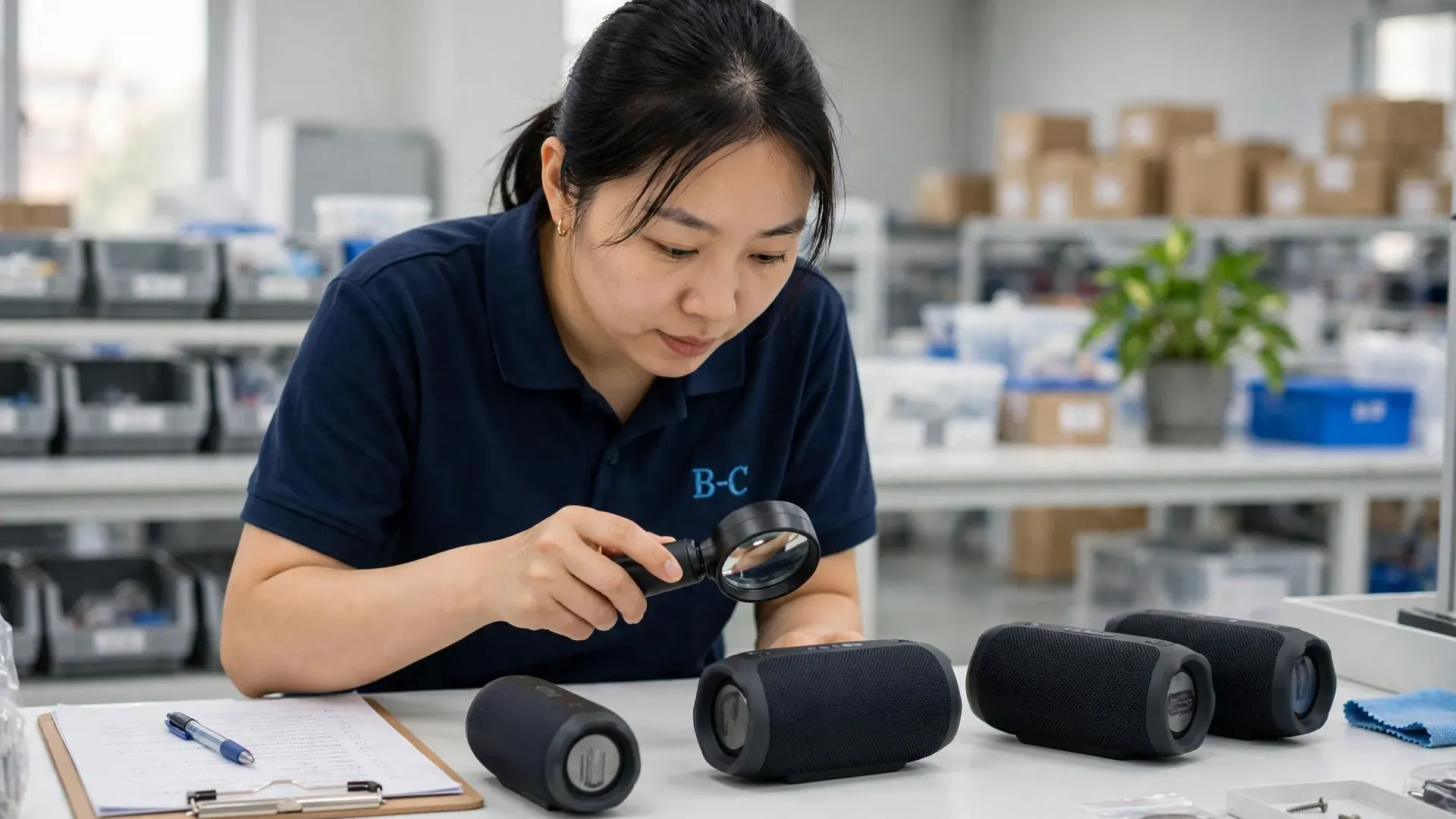
The carton reaches the inspection table and someone has to decide whether the rest of the lot can be loaded. A bag or case can look right on a shelf and still fail in the first week: a coating lifts along a fold, a strap pulls out of its bartack, a wheel housing cracks, a lining smells of damp board after a month in a container. The decision is not a taste judgment but a set of checks at named positions, run against a sealed reference, with a result that either releases the batch or stops it.
We run these checks for importers and brand owners who have a supplier and are setting the release condition for the next lot. The seven sections follow our working order: where we look, what we do at the bench, what we compare, and what fails.
The reference pack: what must be sealed before the first carton
Before a carton is opened, one folder and one sealed unit have to be on the table. The folder carries the order line, SKU, batch code, specification revision, packing list, market label, color standard and carton artwork. The Golden Sample is sealed twice: one copy at the factory, one in our office, each signed across the seal.
Photos and showroom units are not a reference. Production units are compared with the sealed unit, not with a photo on a phone. A photo fixes a shape, not a hand feel, a coating sheen, a stitch density or a hardware finish. When sample and specification disagree, the specification governs dimensions and construction; the sealed sample governs appearance and hand.
We open the pack at the factory and read it against the order. The seal must be intact, the cartons must carry the batch code in the pack, the label file must match the destination market, and the artwork revision must match the carton. If an item is missing, or the sample revision does not match the order, the inspection does not start.
The sample shows what the approved unit looked like, not that this lot was made to it. A missing or mismatched sample, a sample older than the order, a missing label or artwork file, or cartons not tied to the pack: any one stops the inspection.
Fabric, coating, and color: the surface the customer touches first
Fabric, coating and color are read where the bag flexes, rubs and shows. On a soft bag that means the main panel, gusset, bottom, flap edge, binding and the cut edge inside the pocket. On a hard case it means the shell, frame, corner bumpers and wheel housing.
We open the main compartment, turn the panel so its inside faces the light, and fold a coated section along the line it will fold in use. Then we look at the crease and the cut edge, where a coating fails first: a white line, a lift, a chalky surface or bare substrate. Two units, one from the first carton and one from the last, are compared under the same lamp at the same angle.
The baseline is the material callout and weight on the specification, the finish on the approved sample, and the hand of the sealed unit. A shade band across panels from different rolls fails the lot even when each panel matches a swatch. A crease that will not fall out, an oil mark, a slub in a visible area, a reversed grain or a coating that lifts at the fold all fail the unit.
Chemical and labeling requirements belong to your market and your laboratory; we issue no compliance conclusion.
Stitching, seams, and stress points: where a bag fails under load
Stitching fails first where load concentrates: the handle and strap roots, D-ring tabs, zipper ends, bottom corners, the gusset and the top edge. A seam that looks tight outside can be loose inside, where the lining hides it, so we turn the bag out and read both faces.
We run a finger along the stitch line, flex the seam, and pull the strap root by hand in the direction the bag is carried. At the root we look for the bartack: present, centered on the strap, and stitched through the layers that take the load. Along the seam we look for skipped stitches, loose thread, needle holes, puckering, a seam that grins open, a raw edge where binding is specified, and thread that does not match the approved color. We count stitches over a measured length rather than writing that the stitching is fine.
The comparison is the seam construction in the specification and the sealed sample's density and hand. A skipped stitch at a stress point fails the unit, and so does a seam that opens under hand tension, a bartack beside the strap instead of across it, a spinning rivet, or a needle fragment anywhere in the bag. The note records the position and the number of units affected.
Zippers, sliders, hardware, and locks: the small parts that stop a sale
We run every zipper from closed to open and back, and on a double zipper we run both sliders and check that they meet. We try to part the chain behind the slider with thumb pressure, press the self-lock, and pull the tab at an angle rather than straight out. The bag is filled to its normal load first, because a zipper that runs free empty can catch at the gusset curve.
We open and close every buckle, snap, hook and lock, run a gloved hand along the edges for a burr, and check the plating at the D-ring, strap keeper and lock face. A lock is checked against the type named in the specification for the destination market, whether that is a TSA-style lock or a combination lock, rather than a general assumption about what a case should carry.
The sealed sample provides the pull feel, the hardware color and the finish; the specification provides the type and the placement. A missing tooth, a chain that splits behind the slider, a slider that moves without releasing its lock, a tab that bends or detaches, an edge that catches the glove, plating that flakes at a contact point, rust at a pivot, or a lock that opens without its key all fail the unit. We record the position and the carton number.
Dimensions, capacity, and weight: the numbers the listing promises
Dimensions decide whether the listing is true. We measure the outside at its widest points with the trolley extended and the wheels included, then measure the body, the gusset depth and the internal opening a customer will use. Capacity is checked against the internal dimensions, not the external silhouette.
Measuring points are marked on the bench, and the same tape, caliper or scale is used on the sample and the production units. We measure three units from the first, middle and last carton, with the bag filled to the shape it will have in use. The finished weight includes the tags and the detachable strap that ship with the unit. The tolerance is the one agreed before inspection; there is no house number that applies to every bag.
A reading outside that tolerance fails the unit. So does a batch in which one unit differs enough to change the listing claim, a weight outside the specification, or a capacity statement the internal dimensions do not support. The note carries the measured values and the points where they were taken; a word like "fine" is not a measurement.
Carry and wheel systems: straps, handles, trolley, wheels
Carry systems are tested loaded. We load the handle with the agreed method and weight, lift the bag clear of the bench, hold it, set it down, then read the stitches and rivets at the root. On a backpack we load the shoulder straps and check the anchors and back panel; on a handbag, the handle, rings and closure; on a case, the trolley through its full travel, locked at each position and rocked side to side.
Wheels are checked on the floor, not in the hand. We roll the loaded case in a straight line and through a turn, listen for a flat spot or a rumble, and watch the housing where it meets the shell. The case is stood empty and loaded to see whether it stays upright and the feet carry it evenly.
The sealed sample sets the handle height, the trolley play and the wheel feel; the specification sets the wheel type, the handle positions and any load rating. A pulled anchor, a spinning rivet, a handle that will not return, a trolley that collapses under load, play beyond the agreed limit, a binding or wobbling wheel, a cracked housing or a case that will not stand all fail.
Lining, odor, mold, and the packed carton: the defects that appear after the boat
Lining, odor and moisture are the defects that arrive after the boat. We open cartons from the middle and last row and smell inside as soon as they open. A musty or chemical smell that does not clear after airing is a finding. We turn the lining out, run a hand along the bottom seam and pocket corners, and look for a lining that lifts from the bottom board, damp patches, stains, mold spots and rust on the zipper tape or rivets. Desiccant placement is checked where specified.
We check the retail box, hangtag, barcode and carton mark against the approved artwork, check the count against the packing list, and weigh the carton, then run the drop test in the agreed method and reopen the carton to look for damage. On the bench we set the production unit beside the sealed sample, run every zipper from end to end, load the handle in the direction of use, roll the case across the floor, and photograph each defect with the carton number in the frame.
In-line inspection during production, pre-shipment inspection on the finished lot and supervision at container loading are three separate gates; this checklist belongs to the second. Inspection and loading are part of our B2B sourcing service, not a standalone checklist download (/b2b-sourcing). We work on 30% deposit and release 70% only once the lot passes, so a failed check has a commercial cost. A lot that fails a check stops at inspection: it is reworked, re-inspected or rejected, and it does not enter container loading supervision.
The report that follows the inspection has its own field standard; the pre-shipment report guide covers it, not this article (/knowledge-hub/product-inspection-china-pre-shipment-report-record).
The checklist does not make the release decision; it gives the decision a basis. What changes between lots is the reference pack, the batch code and the carton condition, so the pack is sealed before the first carton and the sample stays at hand.
Dore Technology Co., Ltd. is the seller of record, with teams in Shenzhen, Dongguan, Nanning and Yiwu. We work with importers and brand owners whose annual purchases of bags and cases are above USD 10,000, with a supplier they intend to keep. Send us the factory name or link behind the bag or case SKU you already buy, and we will run the Free Supplier Audit before your next deposit (/contact-us).