Sourcing Security Cameras from China: Sensors, Night Vision and the App Ecosystem
Sensor size, night vision range and the app behind the camera decide whether a security camera sells or gets returned. Here is how to source them from China without the usual mistakes.
Security cameras are one of the most competitive categories sourced from China — and one of the easiest to get wrong. Two cameras can look identical on a listing, share the same housing and the same "4K" claim, and deliver completely different images at 2 a.m. in the rain. The difference is rarely the price. It is the sensor inside, the night vision design, and the app the customer actually lives with every day.
This guide covers the three decisions that decide whether a security camera order succeeds: which sensor, which night vision, and which app ecosystem. It also covers the certifications, the private-label options and the checks to run before you pay a deposit.
The camera types you will actually be quoted
Most Chinese factories work across the same five forms. Knowing which form fits your market matters more than comparing spec sheets.
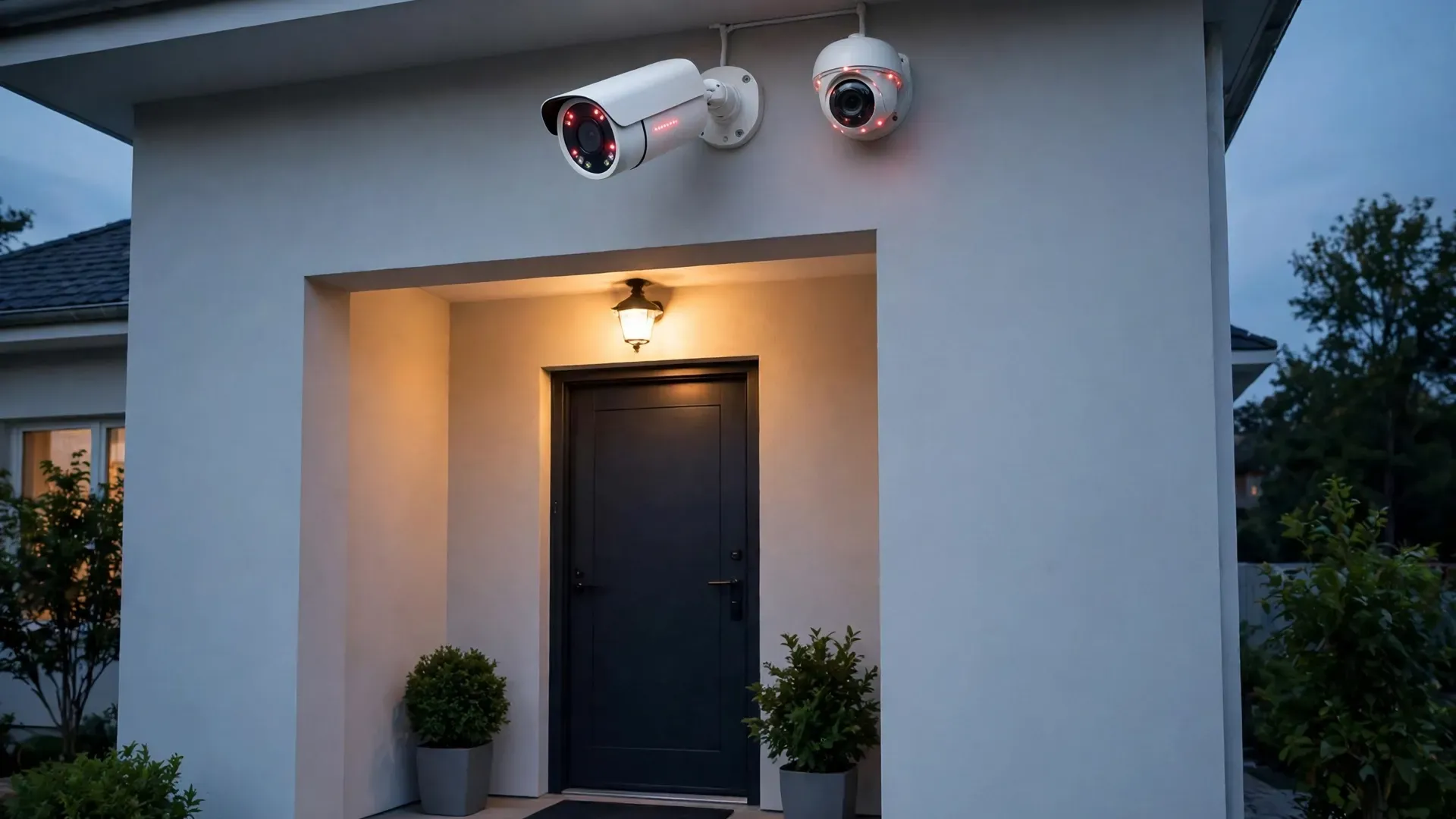
Bullet cameras are the outdoor workhorse: weatherproof, obvious on a wall, easy to aim, and usually the cheapest way to get a long night-vision range. Dome cameras suit indoor and retail use — discreet, harder to tamper with, but the dome cover can soften the image if it gets dirty or scratched. PTZ cameras pan, tilt and zoom, which suits large yards, car parks and warehouses, but they cost more and need a buyer who understands the trade-off between coverage and detail. Wi-Fi cameras are the consumer default: no cable runs, app setup in minutes, and the easiest to sell online. PoE cameras draw power and data through one Ethernet cable, which is the professional choice for multi-camera installs because the connection is stable and the cameras keep working when the Wi-Fi drops.
Then there are the two growth forms: battery cameras, which run for months on a charge and suit places with no power nearby, and solar cameras, which pair a small panel with a battery for locations that are genuinely off-grid. Both are popular with DIY buyers, and both need careful testing — battery life claims are the single most exaggerated number in this category.
Ask your supplier which form they produce in volume, not just which forms they can make. A factory that ships 50,000 Wi-Fi bullets a month and makes ten PTZ units on request will give you a better price and a more reliable product on the bullet line.
Sensors: the number that matters most
Resolution is the number every listing leads with, and it is the least useful number on its own. What matters is the sensor behind it.
Sensor size decides how much light each pixel receives. A 4MP camera on a 1/2.8-inch sensor can look worse at night than a 2MP camera on a 1/2.7-inch sensor, because the larger pixels on the bigger sensor collect more light. When a supplier quotes "4K", ask for the sensor model and size — a Sony, Omnivision or GalaxyCore sensor with a named model number is a real specification; "high-definition CMOS" is not.
Three sensor questions to ask on every quote: the sensor brand and model, the sensor size, and the true resolution (not interpolated). Interpolation — software stretching a lower-resolution image to a higher pixel count — is common in the cheapest cameras, and it produces a file that says 4K and looks like 1080p. A golden sample test, comparing the camera's night image against a known reference camera, catches this before you order in bulk.
Frame rate matters too, especially for cameras watching movement: people, vehicles, entrances. A camera that records at 15 frames per second will blur a person walking past at close range; 25 to 30 fps is the practical standard for motion. Ask for the frame rate at full resolution, not at a reduced resolution.
Wide dynamic range (WDR) is worth specifying for cameras that face doorways, windows or car headlights. Without real WDR, a camera pointed at a bright entrance will show a white doorway and a black interior. True WDR is a hardware feature; digital WDR is a software adjustment and does much less. Ask which one the camera has.
Night vision: IR, colour, and honest range
Night vision is where most buyer disappointment lives, because the headline range is almost always measured in ideal conditions.
Infrared (IR) night vision is the standard: invisible LEDs light the scene and the camera records in black and white. The headline number — "30 metres night vision" — usually assumes total darkness, a reflective surface, and a wide-angle lens. In practice, expect roughly half to two-thirds of the claimed range for a usable image of a person, and less through glass or in rain. Ask for the number of IR LEDs and their power, and test the sample at the actual distance your customers will use it.
Colour night vision is the newer option, sold under names like Starlight or full-colour night vision. These cameras use a larger sensor and a wide aperture to produce a colour image in very low light, sometimes with a small white spotlight for full darkness. The image is genuinely better for identifying people and vehicles — colour matters when a customer is describing a car or a jacket to the police. But colour night vision needs some ambient light to work at all; in true darkness it falls back to IR or to its spotlight. If your market is rural properties with no street lighting, IR is still the safer choice.
Two practical checks for any night-vision claim: test the sample in a dark room at the distance you intend to sell, and look at the image of a moving person, not a still object. A camera can hold a still scene at 20 metres and still smear a walking person into a blur.
The app ecosystem: the part customers judge you by
A security camera is not a standalone product. It is a camera plus an app plus a cloud service, and the app is the part your customer touches every day. A camera with good hardware and a bad app gets returned; a camera with average hardware and a good app gets recommended.
Most Chinese cameras run on one of three app bases. The largest is the Tuya / Smart Life platform, a shared ecosystem used by hundreds of brands. Its advantage is maturity: stable servers, a familiar interface, and compatibility with smart home systems. Its disadvantage is that your product looks like every other Tuya camera, and your brand is one label inside someone else's app. The second option is a factory's own app, built on a chipset platform such as Ingenic, Hisilicon or SigmaStar. These can be rebranded with your logo and colours, but the quality varies widely — test the app yourself on both iOS and Android before you commit, including push notifications, playback, and the setup flow. The third option is a fully custom app, which only makes sense at serious volume, because the development and maintenance cost is real and ongoing.
Four questions to settle the app decision. Does the camera support ONVIF and RTSP? These open standards let the camera work with third-party recorders and software, which matters to professional installers and to any buyer who does not want to be locked into one app. Where is the cloud data stored, and for how long? Customers in Europe and the US increasingly ask this, and the answer affects your compliance position. Does the app work without a subscription for the basics — live view and motion alerts? Cameras that hide basic features behind a paywall generate the angriest reviews. And who maintains the app? An app that stops receiving updates is a product with an expiry date.
Cloud storage deserves a specific note. Many suppliers offer a free trial period — 30 days is common — and then charge a monthly fee. Make sure you know the trial length, the price after it, and what happens to recorded footage if the customer does not pay. Sell the camera with the storage terms stated clearly, not discovered after purchase.
Certifications and compliance: ask before you order
Certifications are not a checkbox to confirm at the end. They decide whether your product can legally be sold in your market, and they take time and money to obtain.
For the EU, the baseline is CE, RoHS and RED (radio equipment, for any camera with Wi-Fi). For the UK, UKCA applies. For the US, FCC. These are per-model certifications, tied to the exact hardware and radio module — a certificate for a different model does not cover yours. Ask the supplier for the certificate number and check it against the issuing body's records; a certificate that cannot be verified is not a certificate.
Two newer compliance areas catch first-time camera buyers out. The EU General Product Safety Regulation (GPSR), in force since December 2024, requires product labelling and traceability information for goods sold in the EU — your camera, its packaging and your listing all carry obligations. And data protection rules apply to the app and cloud side: if your camera stores footage or account data, your privacy policy and your supplier's data handling both matter, and your customers will ask.
In the US, be aware that some government and critical-infrastructure buyers are restricted from certain Chinese camera brands and chipsets under the NDAA. That does not affect ordinary consumer sales, but if your customer base includes government, education or infrastructure projects, check the component and brand lists with your buyer before you commit to a platform.
OEM and private label: what is actually available
Security cameras are one of the most OEM-friendly categories from China, but the depth of customisation depends on your volume.
At low volumes, private label usually means your logo on the housing, your brand on the box, and your name in the app splash screen — the factory's app, your label. At mid volumes, you can usually get a rebranded app with your colours and logo, custom packaging, and a custom startup sound or voice prompt. At high volumes, you can specify the sensor, the lens, the housing colour, the app features and the cloud storage terms.
Three things to confirm in writing before you pay for customisation: who owns the tooling and the mould (usually you, if you paid for it — get it in the contract), who owns the app customisation and what happens to it if you change factory, and whether the firmware can be updated after the goods ship. Cameras ship with firmware bugs; the ability to push an update is the difference between a fix and a return.
MOQs for cameras are typically lower than buyers expect — many factories will private-label 500 to 1,000 units — but the app customisation often has its own minimum or a separate setup fee. Ask for the two numbers separately.
How to check a camera before you commit
A security camera cannot be verified from a spec sheet. The checks are practical and cheap, and skipping them is the most expensive mistake in this category.
Start with a golden sample: one unit, tested in the conditions your customers will actually use — daylight, dusk, full darkness, rain if it is an outdoor model, and a moving person at the distance you advertise. Compare its night image against a reference camera you already trust.
Test the app end to end on both iOS and Android: setup, live view, motion alerts, playback, and sharing access with a second phone. Count the taps to set up a camera; if it takes more than five minutes for a first-time user, your customers will struggle.
Run the IP rating test that matches the claim. An IP66 outdoor camera should survive a hose test without water inside the housing. An IP65 camera should handle rain but not a jet. If the supplier claims IP66, ask for the test report — and test the sample yourself.
Check the lens: a wide-angle lens covers more area but makes distant faces small; a narrower lens sees further but covers less. Match the lens to the use case — a driveway camera and a living-room camera want different lenses — and say so in your listing, so customers buy the right one.
Finally, check the packaging and the manual. A camera that arrives with a manual in broken English and a box that does not state the app name will generate support tickets before it generates reviews. Ask for the manual text before production, not after.
What we can and cannot do
We can find and verify camera factories in Shenzhen and the surrounding region, check sensor models and certifications against your requirements, arrange golden samples and test them against your own reference camera, manage the private-label and app rebranding process, and inspect production — including night-vision tests, app pairing tests on both platforms, and waterproof checks — before the goods ship. We can also consolidate camera orders with other products from different suppliers into one shipment.
What we cannot do is guarantee a camera will pass a certification it has not been tested for, or make a camera do something its hardware cannot — no app update will turn a small sensor into a good night camera. We cannot supply cameras that infringe another brand's trademark or firmware, and we will not help you relabel a camera to pass it off as a different brand. And we cannot override a platform's rules: if a marketplace or a government buyer restricts a particular chipset or brand, that restriction applies to the finished product, not just the component.
The bottom line
Buy the sensor, not the resolution number. Test the night vision at the distance your customers will actually use, with a moving person. And spend as much time testing the app as testing the camera — it is the part your customer lives with. Get those three right, confirm the certifications for your market, and put the private-label and firmware terms in writing before you pay. The factories that make good cameras are easy to find in China; the skill is in knowing which specification is real, which claim needs testing, and which app your customers will still be happy with a year from now.
If you want a factory quote for security cameras — sensor, night vision range, app and private label included — get a factory quote in 24 hours. Send us the camera type, the quantities and the market you are selling into, and we will come back with verified factories, real sensor specifications and a sample plan.
Related: EU GPSR Is in Force: What Importers from China Must Fix on Labels and Paperwork — the labelling and traceability rules that apply to cameras sold in the EU; Sourcing Portable Power Stations from China: Battery Certifications and Shipping Rules — the battery and certification checks that apply to battery and solar cameras too; Security Cameras, CCTV & IP Cameras — our security camera range, with sensor and night-vision specifications.