Aug 26, 2026Sourcing Guides
Bluetooth Speaker Quality Control Checklist Before Shipment
Use this pre-shipment quality-control checklist to inspect portable Bluetooth speakers, packaging, labels, batteries, functions, and cartons before export.
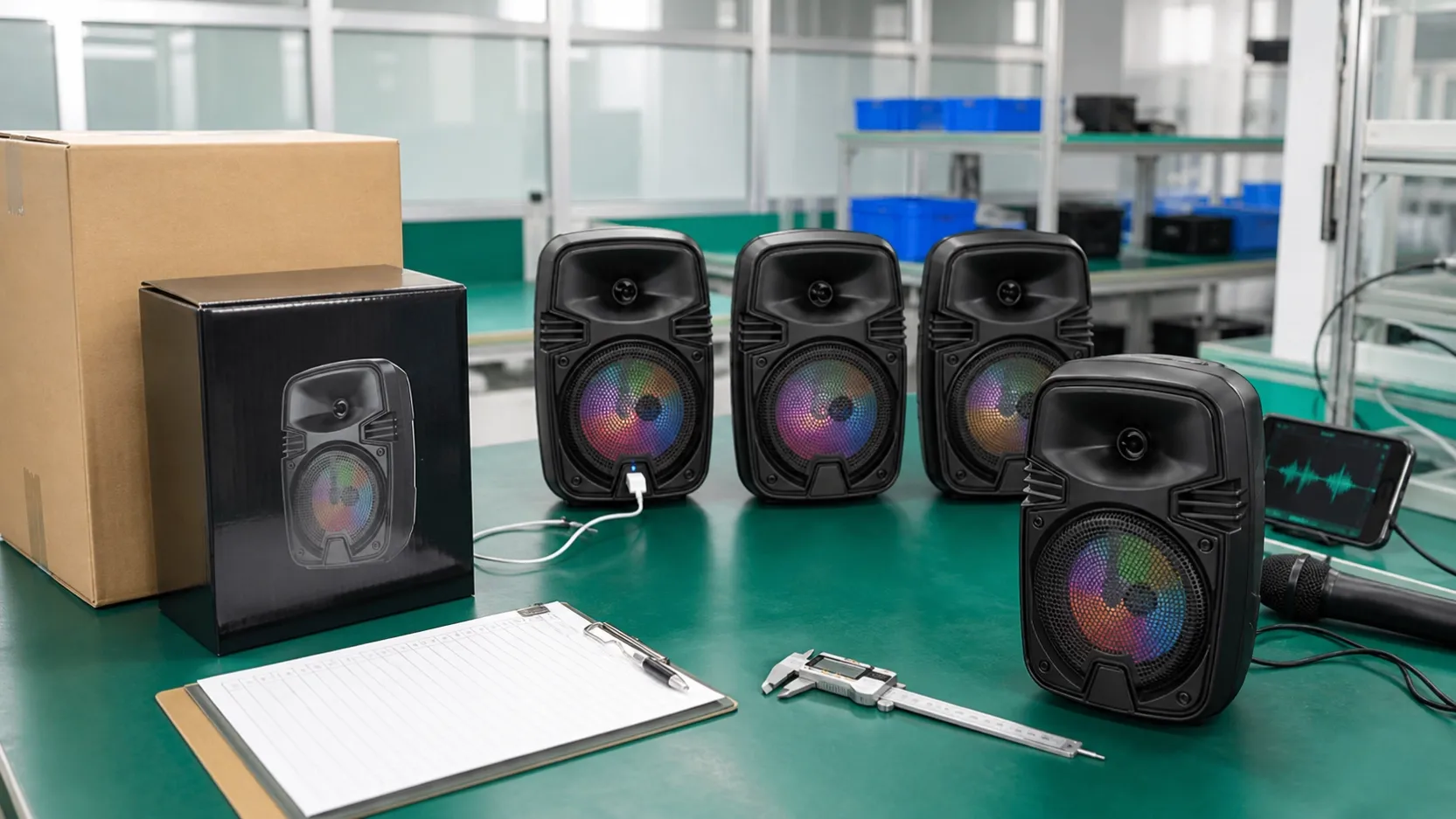
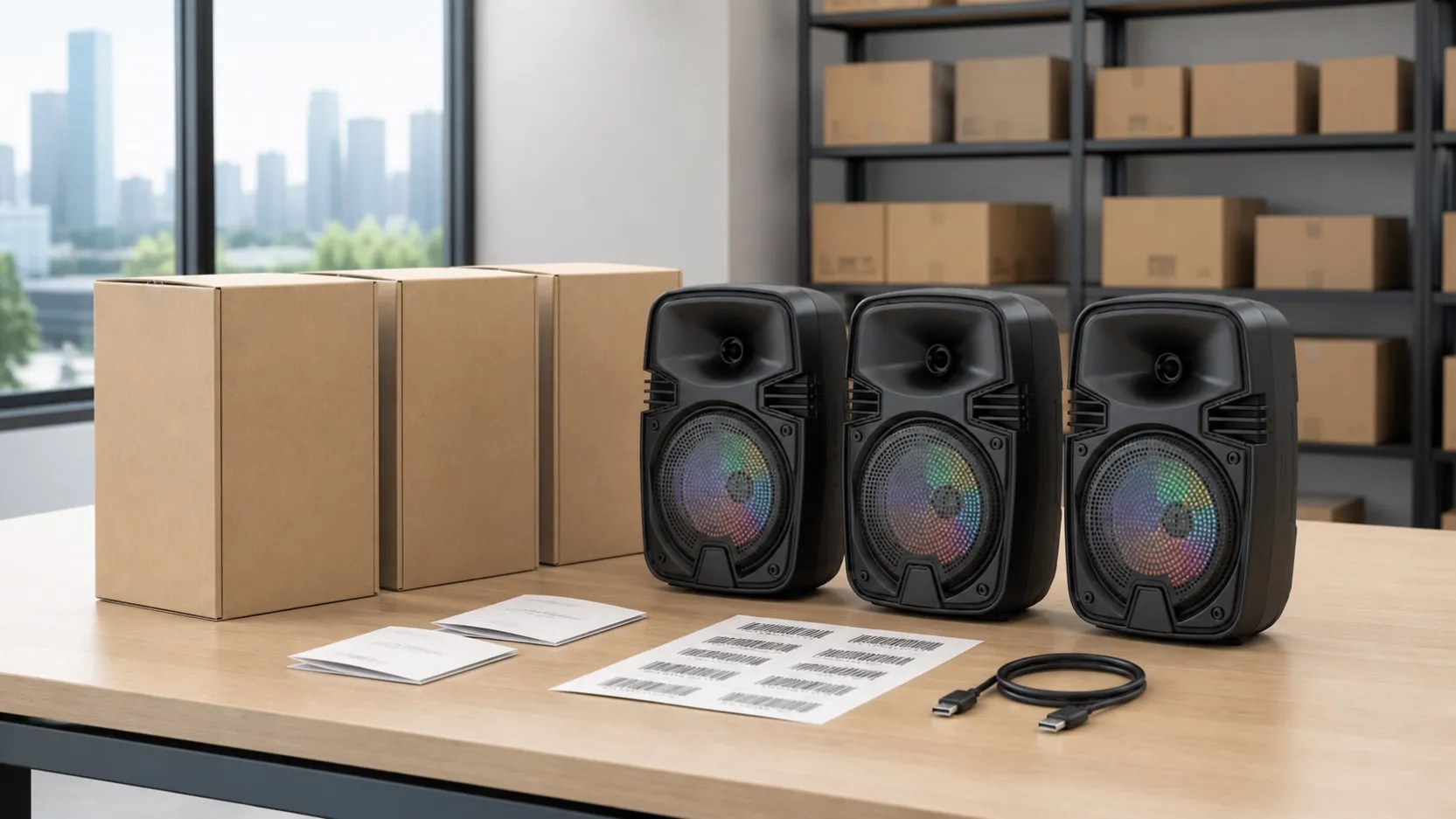
Portable Bluetooth speakers can pass a quick power-on test and still create costly problems after arrival. A disciplined pre-shipment inspection should confirm the functions buyers sell, the labels importers rely on, and the packaging that protects every unit in transit.
This checklist is designed for importers, distributors, and private-label buyers preparing a Bluetooth speaker shipment from China. It uses a compact 4-inch portable speaker as a practical reference, but the process applies to many entry-level and mid-range models.
Why Bluetooth Speaker Quality Control Must Happen Before Shipment
Once cartons leave the factory, correcting a wrong label, weak charging port, missing cable, or inconsistent accessory pack becomes slower and more expensive. Pre-shipment quality control creates a final decision point while the goods are still accessible.
The inspection should compare production units with the approved specification and Golden Sample. It should also record defects clearly enough for the supplier and buyer to agree on corrective action before release.
1. Freeze the Approved Reference Before Inspection
A useful inspection starts with a controlled reference. Do not ask an inspector to judge quality from a product photo alone.
Prepare the inspection file
Approved product specification and purchase order
Golden Sample or signed sample photos
Approved logo, color, label, manual, and carton artwork
Accessory list and packing method
Buyer-defined critical, major, and minor defect examples
Destination-market requirements confirmed for the exact model
If this is your first private-label order, review our private-label Bluetooth speaker first-order checklist before production begins. Inspection cannot compensate for specifications that were never confirmed.
2. Confirm Quantity, Model, and Carton Identity
Start with the shipment as a whole. The inspector should reconcile the production quantity, model numbers, color breakdown, and carton count with the purchase order and packing list.
Count finished cartons and verify units per carton.
Check carton marks, model codes, destination marks, and barcodes.
Confirm that mixed colors or variants are separated and identified correctly.
Record any short quantity, overage, or unsealed cartons.
This step is especially important when several products will be consolidated into one shipment. Clear carton identity reduces warehouse mistakes and makes loading verification easier.
3. Inspect Appearance and Assembly
Appearance defects are easy for end customers to notice. Inspect the cabinet under consistent lighting and compare color, texture, and branding with the approved sample.
Exterior checks
No cracks, sharp edges, dents, glue marks, scratches, or visible gaps
Grille, buttons, handles, straps, feet, and decorative parts are secure
Logo position, printing, and color match approved artwork
Ports and controls are aligned and clearly marked
Cabinet does not rattle when handled gently
For the compact reference model, also confirm the black cabinet, 4-inch speaker format, RGB lighting area, Type-C port, and supplied charging cable against the approved sample.
4. Test Every Promised Function
A Bluetooth speaker should be tested as a product, not merely switched on. The inspector should follow a repeatable sequence and record the result for each sampled unit.
Power the unit on and check startup behavior.
Pair with a test phone and confirm stable Bluetooth playback.
Test buttons, volume control, track control, and mode switching.
Insert a compatible TF card and USB device if those functions are specified.
Check FM reception where the function is included and local conditions permit.
Verify RGB lighting modes and any on-off control.
Connect the Type-C cable and confirm charging indication.
Listen at several volume levels for distortion, intermittent sound, or cabinet noise.
The reference model is supplier-specified with Bluetooth, TF, USB, FM, RGB lighting, a 500mAh lithium battery, and 3W output. Those values should be treated as model-specific supplier data and verified against the final purchase specification, not assumed for another model.
5. Check Battery and Charging Behavior
Battery-related complaints can damage a product line quickly. The inspection scope should reflect the battery design and the buyer's risk tolerance.
Confirm the specified battery type and declared capacity on controlled documents.
Check charging port fit, cable connection, and charging indicator behavior.
Look for swelling, leakage, unusual heat, odor, or damaged wiring.
Run an agreed functional playback test rather than relying only on a power-on check.
Verify battery, product, and packaging marks required for the destination and transport method.
Transport documents and compliance evidence must be reviewed for the exact battery and model. A factory statement or certificate from a different product should not be accepted as proof.
6. Verify Accessories, Labels, and Retail Packaging
Missing or mismatched accessories are common causes of avoidable claims. Open packed units from the inspection sample and compare every component with the approved packing list.
Correct charging cable and other agreed accessories
English or market-specific manual with accurate model information
Correct barcode, SKU, color label, and importer details where required
Retail box artwork, spelling, warnings, and logo placement
Protective bags, inserts, and cushioning fitted correctly
No Chinese text unless the buyer explicitly approved it for the target market
For more context on positioning a cost-effective model for developing markets, see our guide to portable Bluetooth speaker sourcing for Belt and Road markets.
7. Evaluate Carton Protection and Shipping Readiness
The retail product can be correct while the export packaging is not. Inspect master cartons for strength, sealing, moisture exposure, and accurate shipping marks. Confirm dimensions and gross weight against the packing information.
If drop or vibration testing is part of the buyer's protocol, define the method before inspection. After the test, reopen the carton and check both the packaging and the speaker for hidden damage.
8. Classify Defects and Make a Release Decision
Inspection findings should be classified against the buyer-approved standard. A cosmetic mark and a charging safety concern should not be treated as equivalent.
Critical: a defect that may create a safety, legal, or serious compliance risk
Major: a defect that affects function, saleability, or normal use
Minor: a limited workmanship or appearance issue that does not materially affect use
The buyer should receive a report with quantities, defect photos, test results, and a clear conclusion. If the result fails the agreed criteria, define rework, sorting, replacement, and re-inspection before authorizing shipment.
How B&C Sourcify Supports Speaker Orders
B&C Sourcify can coordinate the workflow from supplier communication to shipment release. Our support can include specification confirmation, Golden Sample control, production follow-up, pre-shipment inspection coordination, packaging and label review, and loading or multi-supplier consolidation.
This is useful when a buyer is combining speakers with other consumer electronics or complementary products. One sourcing account can help align packing information, warehouse arrival, carton identification, and container loading across suppliers.
Learn more about our B2B sourcing service, or send us your speaker specification and target market for a sourcing and inspection plan.
Frequently Asked Questions
Should every Bluetooth speaker be tested before shipment?
The appropriate inspection method depends on order risk, product maturity, and the buyer's agreed quality standard. A sampled pre-shipment inspection is common, while selected functions or risk points may require broader testing. Define the scope before production is completed.
What should a Golden Sample include?
It should represent the approved product appearance, functions, accessories, branding, labels, and packaging. Any approved deviations should be documented so the inspector does not compare production with an outdated sample.
Can one inspection cover several speaker models?
Models can be inspected during the same visit, but each model should have its own specification, sample plan, defect record, and conclusion. Do not let a passing result for one model conceal defects in another.
When should the final inspection take place?
It should be scheduled when production and packing are sufficiently complete for a representative check, while leaving enough time for corrective action. The exact timing should be agreed with the buyer, factory, and inspector.
Request a Bluetooth Speaker Sourcing and QC Plan
Send B&C Sourcify your target market, required functions, branding files, order quantity, packaging needs, and delivery plan. We will help translate them into a supplier brief, sample controls, and a practical pre-shipment inspection checklist for your order.