What MOQ Really Means: How Small Importers Negotiate Lower Minimums
MOQ is a cost structure, not a refusal. Six ways small buyers negotiate lower minimums — unit-price trades, fewer variants, paid tooling, stock-plus-customisation — with golden-sample inspection.
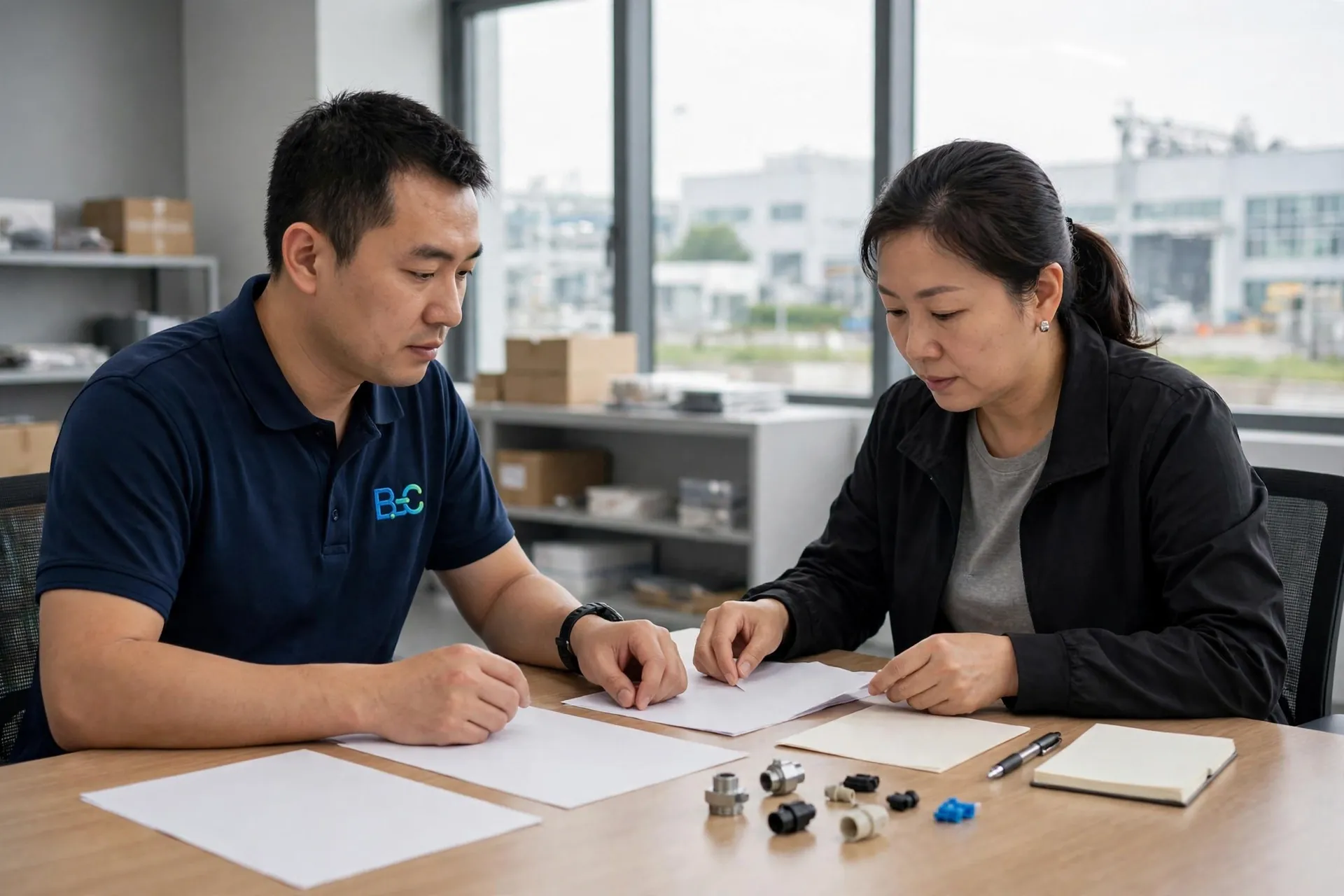
Every small importer meets the same wall at the same moment. The sample is good, the price works, and then the factory names its minimum order quantity: 1,000 pieces. You need 200. The conversation stalls, and most buyers read the number as a refusal. It usually is not. A minimum order quantity is a cost structure wearing the shape of a rule — and once you can see the structure, you can negotiate the number without asking the factory to lose money on your order.
MOQ stands for minimum order quantity: the smallest run a factory will take for a given product. It is not one number with one reason behind it. It is the point where setup costs, material purchases, line time and packaging runs stop being a loss. Understand which of those is doing the work in your case, and you will know which lever actually moves the number.
Why factories set MOQs at all
A factory's costs do not scale down neatly. Before the first unit of your order exists, someone has to set up the line, calibrate the machines, prepare the mould or tooling, and buy the raw material — usually in the supplier's own minimum batches. Those fixed costs are the same whether the run is 200 pieces or 2,000. Spread over 2,000 units, they are a few cents each. Spread over 200, they can double the unit price.
Material is often the binding constraint, not the line. A factory buys fabric by the roll, plastic resin by the bag, cardboard by the sheet count. If your 200 pieces need half a roll of a custom-dyed fabric, the factory either charges you for the whole roll or declines the order. Packaging runs the same way: a custom printed box has its own minimum at the box factory, and that minimum can be higher than the product MOQ itself.
None of this is the factory being difficult. It is the factory telling you, in the only language it has, where its costs sit. The negotiation starts when you stop treating the MOQ as a price to haggle and start treating it as a cost problem to solve together.
The MOQ you see is not always the MOQ that counts
Before negotiating, ask what the number actually covers — because "MOQ 1,000" can mean four different things, and they negotiate differently:
- Per order. 1,000 pieces total, split how you like across colours or sizes. This is the most flexible form, and the easiest to work with.
- Per SKU. 1,000 pieces of each colour, each size, each variant. Four colours means 4,000 pieces. This is where small orders quietly become big ones.
- Per print or mould. The product MOQ is low, but your logo print, custom colour or private mould carries its own minimum — often the real barrier.
- Per material batch. The factory will run 300 pieces, but the material supplier will only sell the input in a quantity that covers 1,000.
Ask the factory to break the MOQ down in those terms before you propose anything. A buyer who asks "is that per SKU or per order?" has already separated themselves from most of the inbox — and the answer tells you which lever to pull.
Six ways to negotiate a lower MOQ
- Take the standard version. Custom colours, custom materials and custom prints are what push minimums up. If you can accept the factory's standard colour, standard material or stock packaging for the first order, the MOQ often drops sharply — sometimes to a few hundred pieces — because the factory is running a configuration it already runs for other buyers. Customise on the second order, once the product has proven itself.
- Pay more per unit for a smaller run. This is the most honest trade in the negotiation, and factories respect it. The factory's fixed costs do not shrink with your order; if you want 200 pieces, offer to carry a larger share of them in the unit price. A 200-piece run at a 20% higher unit price is often a better deal for both sides than a 1,000-piece run at the standard price — you hold less stock, and the factory still covers its costs. Name the trade explicitly: "I understand the setup cost. What unit price makes 300 pieces work for you?"
- Consolidate variants into one run. If the MOQ is per SKU, reduce the number of SKUs. One colour instead of four, one size instead of three, one print instead of two. The total pieces stay the same, but each variant clears its own minimum. This is also the fastest way to find out whether the per-SKU minimum is real or just a quoting habit — factories that can consolidate will often do so when asked directly.
- Show the pipeline, not just the promise. Every buyer says "there will be more orders." Factories have heard it from buyers who never came back. What moves them is evidence: a signed distribution agreement, a listing already live, a pre-order count, a dated reorder plan with quantities. A 200-piece first order attached to a credible 2,000-piece quarter reads very differently from a 200-piece order attached to "we'll see how it goes."
- Separate the tooling cost. If a custom mould or print plate is driving the MOQ, offer to pay for it outright instead of having its cost amortised across the run. The factory's risk drops to near zero on that item, and the MOQ that remains is only the production minimum — usually much lower. Get the arrangement in writing: who owns the mould, where it is stored, and what happens if you move production.
- Start with stock product plus light customisation. Many factories hold blank or standard-spec stock of their best-selling products. A stock product with your label, your hang tag or your retail box added afterwards can ship in the low hundreds — sometimes under 100 pieces — because the factory is not running a production line for you at all. It is the lowest-risk way to test a product, and it keeps your first order out of MOQ negotiations entirely.
What not to do
Do not push a factory below its real cost. A factory that accepts an order it cannot make money on has two options: cut the material, the tolerance or the inspection — all in places you cannot see from overseas — or take your deposit and deprioritise your run until a profitable order fills the line. Either way, the low MOQ you won becomes the quality problem you own. If a factory's number will not move after a fair conversation, that is information, not an insult: the product, the material or the factory is the wrong fit for a small run, and the right move is a different product or a different factory.
And do not invent a large order to get a small one quoted. Factories compare notes, and a buyer caught inflating volume loses the credibility that every future negotiation depends on.
What we do differently
This is where a sourcing agent earns the fee. A single buyer negotiating alone has one order and one factory. We bring the factory several buyers' orders for the same product line, consolidated into one production run — your 200 pieces ride inside a run the factory actually wants. We also know which factories in a given category genuinely run small batches well and which ones only claim to, because we have watched both kinds produce.
The process around a small order is the same as around a large one: a golden sample is sealed before production, inspection runs against it, and the balance is released only after the pre-shipment check passes. A trial order is not a lesser order. It is guarded exactly like the hundredth shipment — which is the point of starting small in the first place.
What we can and cannot do
We can negotiate MOQs down through consolidation, variant reduction and honest unit-price trades, and we can tell you plainly when a factory's minimum is real and when it is a starting position. We can source stock product with light customisation for genuinely small test orders, and we can run the full inspection process on a 200-piece run.
What we cannot do is make a factory run below cost without consequences, and we will not pretend otherwise. If the numbers say a product needs 1,000 pieces to be made properly, we will tell you that — and help you find the product, or the factory, where a small order works.
The bottom line
MOQ is not a wall. It is a cost structure, and cost structures can be rearranged: fewer variants, standard materials, a higher unit price, a paid mould, a credible pipeline. The buyers who get small orders made are not the ones who argue hardest. They are the ones who understand what the factory is actually paying for — and offer to carry a fair share of it.
If you have a product and a factory's MOQ is standing in the way, send us the spec for a factory quote within 24 hoursand we will read the quote against the factory's real costs. The first read is free, and if the answer is "this one needs a different factory," that is what we will say.
Related: Custom Packaging & Branding Solutions — packaging minimums often set the real floor on a small order; this page covers what can be customised at low volume and what cannot.