Sourcing Pet Supplements OEM in China: Formula, Registration and Label Rules
Pet supplements are a formula and paperwork business before they are a price business. How to source OEM pet supplements from China — formula, registration and labels — without a customs surprise.
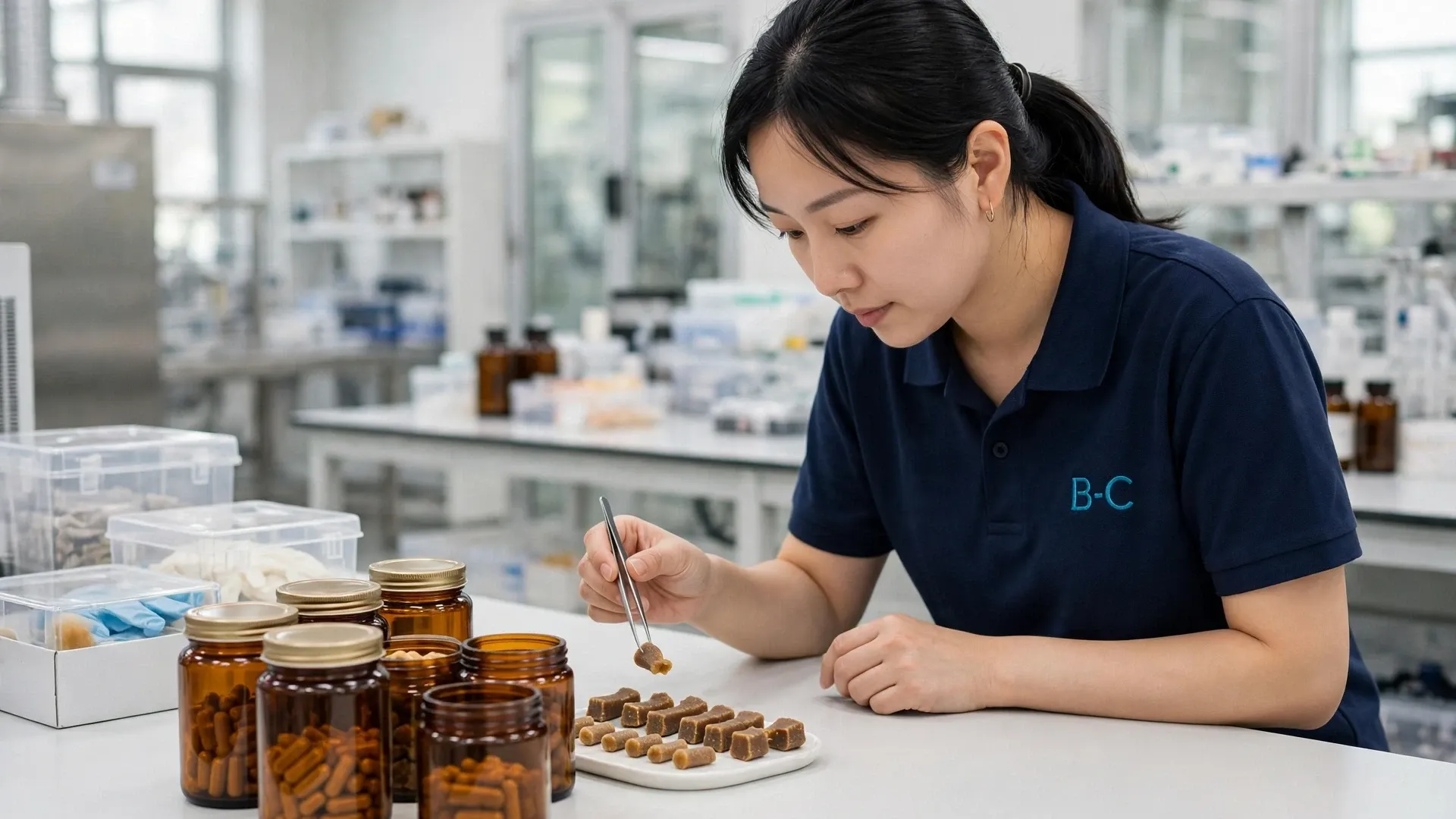
Pet supplements — joint chews, probiotics, skin and coat oils, calming tablets, dental sticks — are one of the fastest-growing categories in the pet trade, and China makes most of them. The factories are experienced, the ingredient supply chain is deep, and private-label production is routine. But pet supplements sit in an awkward regulatory space: they are not pet food, they are not veterinary medicine, and the rules that decide whether your product clears customs, lists on Amazon, or stays on a retail shelf differ sharply between the United States, the European Union, and the factory's own market.
That makes this a formula and paperwork business before it is a price business. The buyers who run into trouble are rarely the ones who paid too much. They are the ones who approved a formula without owning it, shipped a label their market does not accept, or discovered at the border that their product needs a registration they never applied for.
Start with the formula — and who owns it
Every OEM pet supplement project starts from one of three places: your own formula, a factory's existing formula, or a formula developed jointly. Each route has different costs and different risks, and the choice should be made deliberately, not by default.
Your own formula gives you the most control. You specify every ingredient, its form, its inclusion rate, and the finished product's specification — appearance, weight, hardness for a chew, palatability, and shelf life. The factory's job is to make it to that specification and to tell you honestly when an ingredient is hard to source, unstable in the format you chose, or priced in a way that breaks your target. Bring the formula in writing, with tolerances, not as a verbal description.
A factory's existing formula is the fastest route to market. The factory has already made it, the production line is set up, and the minimum order is usually lower. The trade-off is exclusivity: the same formula may be sold to other buyers, sometimes under a different label and sometimes under a very similar one. If your brand depends on a distinctive product, ask in writing whether the formula is exclusive to you, for how long, and what happens if the factory sells it to someone else. A formula that ten other brands use is not a private label — it is a shared product with your logo on it.
A jointly developed formula sits in between. You bring the concept and the target market; the factory's formulator brings the ingredient knowledge. This can produce a good product, but it creates the most common ownership dispute in this category: when the relationship ends, who owns the formula? Settle it in the contract before development starts. The cleanest arrangement is that you own the formula and the factory is licensed to produce it for you alone. If the factory insists on keeping the formula, at minimum get a written agreement that it will not sell the same formula to another buyer in your market for an agreed period — and decide whether that protection is worth what you are giving up.
Whatever route you take, get three documents before production. First, the full formula with ingredient names, forms and inclusion rates. Second, the specification sheet for the finished product: weight per piece, active-ingredient content per serving, moisture limits, and the test methods used to verify them. Third, a written statement of the ingredient sources — which supplier provides each key ingredient, and whether the factory will tell you before it changes a supplier. An ingredient change without notice is how a product that passed its first test fails its second batch.
Registration: the step buyers discover too late
Pet supplements are regulated differently in every major market, and the registration position of your product can decide whether it is sellable at all. This is the step most often discovered at the border, when it is too late to fix cheaply.
In the United States, pet supplements are regulated as animal food, and the rules are administered through the FDA's Center for Veterinary Medicine together with state feed-control officials and the AAFCO ingredient definitions. There is no pre-market approval for most pet supplements, but the ingredients must be recognised — either as approved food additives, as generally recognised as safe for the intended use, or as ingredients with an AAFCO definition — and the product must be safe, properly labelled, and free of drug claims. The National Animal Supplement Council (NASC) runs a widely recognised industry quality programme: member companies submit to audits and follow quality standards, and the NASC seal on a label signals that the product comes from a company that has been through that process. It is not a legal requirement, but many US retailers and distributors treat it as a practical one.
In the European Union, pet supplements fall under feed law. Additives used in pet food and supplements must be authorised under Regulation (EC) No 1831/2003, and the product must comply with the EU's feed labelling and hygiene rules. The FEDIAF (European Pet Food Industry Federation) guidelines are the practical reference most European buyers use for nutritional and labelling questions. Ingredients that are legal in one market are not automatically legal in another — an additive authorised in the EU may not be recognised in the US, and vice versa.
In China itself, pet food and related products are regulated by the Ministry of Agriculture and Rural Affairs under the pet feed management rules. Factories that produce pet food and supplements for export must hold the relevant production licences, and imported pet food is subject to registration with Chinese customs authorities. When you source from a Chinese factory, confirm that the factory holds the licences that cover the product you are ordering — a factory licensed for pet food is not automatically licensed for every type of supplement, and the licence scope matters.
The practical rule: decide your target market first, then ask the factory — in writing — whether the product as formulated can be sold there, and what registrations, notifications or documentation that market requires. Do not accept "we have exported this before" as an answer. Ask where it was exported, under what registration, and whether the documentation can be provided for your market specifically. Regulations change, and where this article refers to a rule, check the latest official text before relying on it.
Labels: where most listings fail
Labels are where pet supplement orders most often fail — at customs, on Amazon, or on a retailer's compliance desk. The rules are detailed, and they differ by market, but the common failure points are the same everywhere.
First, the product's identity. The label must state clearly what the product is, in the terms your market's rules require — a pet supplement, a complementary feed, a pet food for particular nutritional purposes — and it must not describe the product as a medicine. Any word that implies the product treats, cures or prevents a disease turns a supplement into an unapproved drug in most markets, and that is a customs and platform problem, not a marketing opportunity. "Supports joint health" and "treats arthritis" are not the same claim, and the distance between them is the difference between a legal product and a seized one.
Second, the ingredient list. List every ingredient in the order your market requires, with the active ingredients and their amounts per serving. If the product is a chew, state the weight per chew and the active content per chew, not just per kilogram of product. Vague ingredient names — "herbal blend" without a breakdown, or a proprietary blend with no amounts — are a red flag for regulators and for serious buyers alike.
Third, feeding directions and warnings. State the recommended daily amount by the animal's weight, the animal species and life stage the product is for, and any warnings — for example, that the product is not for human consumption, that it should be kept out of reach of children, and that a veterinarian should be consulted for animals that are pregnant, nursing, or on medication. These are not marketing copy; they are part of the product's compliance file.
Fourth, the details that delay shipments: the net weight, the batch or lot number, the expiry or best-before date, the country of origin, and the name and address of the responsible business in the market of sale. Amazon and other platforms check label compliance as part of listing approval, and a missing batch number or an expiry date in the wrong format is enough to hold a listing.
Agree the label with the factory before production — the artwork, the text in the market language, and who is responsible for checking it against the market's rules. A product that is manufactured correctly but labelled wrong is a product that waits in a warehouse while new labels are printed, and in this category, a relabelling job is expensive because the label is often printed directly on the jar or pouch.
Choosing the factory: what to verify beyond the price
Not every factory that makes pet food can make pet supplements well. The two categories share ingredients but not production discipline: supplements need precise dosing, consistent active content, and stability testing that bulk pet food does not.
Ask for the factory's production licence and check that it covers the product type you are ordering. Ask whether the factory has its own laboratory or works with an accredited third-party laboratory, and what it tests: active-ingredient content, microbial limits, heavy metals, and moisture are the usual checks. Ask for a recent test report for the same product or the same formula — and read it the way you would read a food-contact report: check that it names your product, that the tests match your market's requirements, that the report is current, and that it comes from an accredited laboratory.
Ask about the factory's experience in your market specifically. A factory that has exported pet supplements to the EU for five years will already know the additive and labelling rules; a factory that has only sold domestically may not, however good its production is. Experience in the target market is worth more than a low unit price.
And ask how the factory handles the ingredient supply chain. The active ingredients in a pet supplement — glucosamine, probiotics, fish oil, specific vitamins — are the expensive part of the product, and they are also the part most vulnerable to substitution. A factory that buys its glucosamine from a named supplier and can show a certificate of analysis for each batch is a different proposition from one that buys on the spot market and cannot say what arrived this month. Write the ingredient specification and the certificate requirement into the purchase contract, not into a chat message.
If you need a supplier checked against these points before you commit, get a factory quote in 24 hours — send the product, the formula or concept, and the target market, and we will verify the factory, the licences and the registration position before you pay a deposit.
Samples, stability and the checks that matter
Samples are where most pet supplement problems are caught, if you know what to test. When the sample arrives, check these points before approving production.
First, the basics: weight, size, appearance, smell and palatability. A chew should be consistent in weight from piece to piece — weigh ten pieces and compare. A product that smells rancid, or that pets refuse, has a problem that no laboratory report will fix.
Second, the active content. Send a sample to an independent laboratory and ask it to test the active ingredient content against the specification. This is the single most valuable test in this category: a supplement that contains half the stated active ingredient is a supplement that does not do what the label says, and it is the most common quality failure in private-label supplements. Do this on the sample and again on the first production batch.
Third, stability. Ask the factory for stability data — how the active content, moisture and appearance hold up over the claimed shelf life, and under what storage conditions. A product with a two-year shelf life on the label needs data that supports two years, not a guess. If the factory has no stability data, budget for an accelerated stability test before you commit to a large first order.
Fourth, packaging compatibility. Soft chews in a pouch, oils in a bottle, powders in a jar — each format has its own failure mode. Check that the seal holds, that the desiccant (if used) is the right type and quantity, and that the packaging protects the product for the full transit time, not just the week it sits in the factory.
Finally, confirm that the production batch matches the approved sample — same formula, same ingredient sources, same specification. If anything changed between sample and production, the factory should have told you before production started, not after the goods shipped.
What we can and cannot do
We can find factories that make pet supplements to your formula or to a factory formula you choose, verify the factory's production licences, confirm which registration and labelling rules apply in your market, arrange independent testing of active-ingredient content, negotiate formula ownership and exclusivity in writing, and inspect the goods before shipment — including a laboratory check against the approved sample.
What we cannot do is guarantee that a product is registrable in your market, or approve a formula on your behalf. Registration decisions rest with the authorities in your market, and the final call on a formula, a claim, or a label belongs to you and your regulatory adviser. We also cannot make an ingredient legal in a market where it is not authorised — if an ingredient is not permitted, the only fix is to reformulate. And we cannot approve a sample without your say-so on the flavour, format and branding: those decisions are yours, and we will not guess them.
The bottom line
Sourcing pet supplements OEM from China is a formula and paperwork exercise before it is a price exercise. The factories are capable, the ingredient supply chain is deep, and the prices are competitive. The orders that go wrong are the ones where the formula was never owned in writing, the registration position was never checked for the actual target market, or the label made a claim the product could not legally carry.
Before you place a first order, get three things in writing: who owns the formula and whether it is exclusive to you; the registration and labelling rules for your target market and who is responsible for meeting them; and the finished-product specification, including active content per serving and the laboratory that will verify it. With those three settled, the rest of the order — flavours, packaging, quantities, shipping — follows naturally.
If you are sourcing pet supplements and want the factory, formula and registration position verified before you commit, get a factory quote in 24 hours — tell us the product, the target market and the volumes, and we will start with the supplier and compliance checks.
Related: Pet Supplements OEM/ODM for Dogs and Cats — custom-formula pet supplements sourced from China with full inspection before shipment.