Sourcing Guides
Sourcing Portable Power Stations from China: Battery Certifications and Shipping Rules
A portable power station is only as shippable as its battery paperwork. This guide covers the specs that matter, the certification stack, and the rules that decide how your order travels.
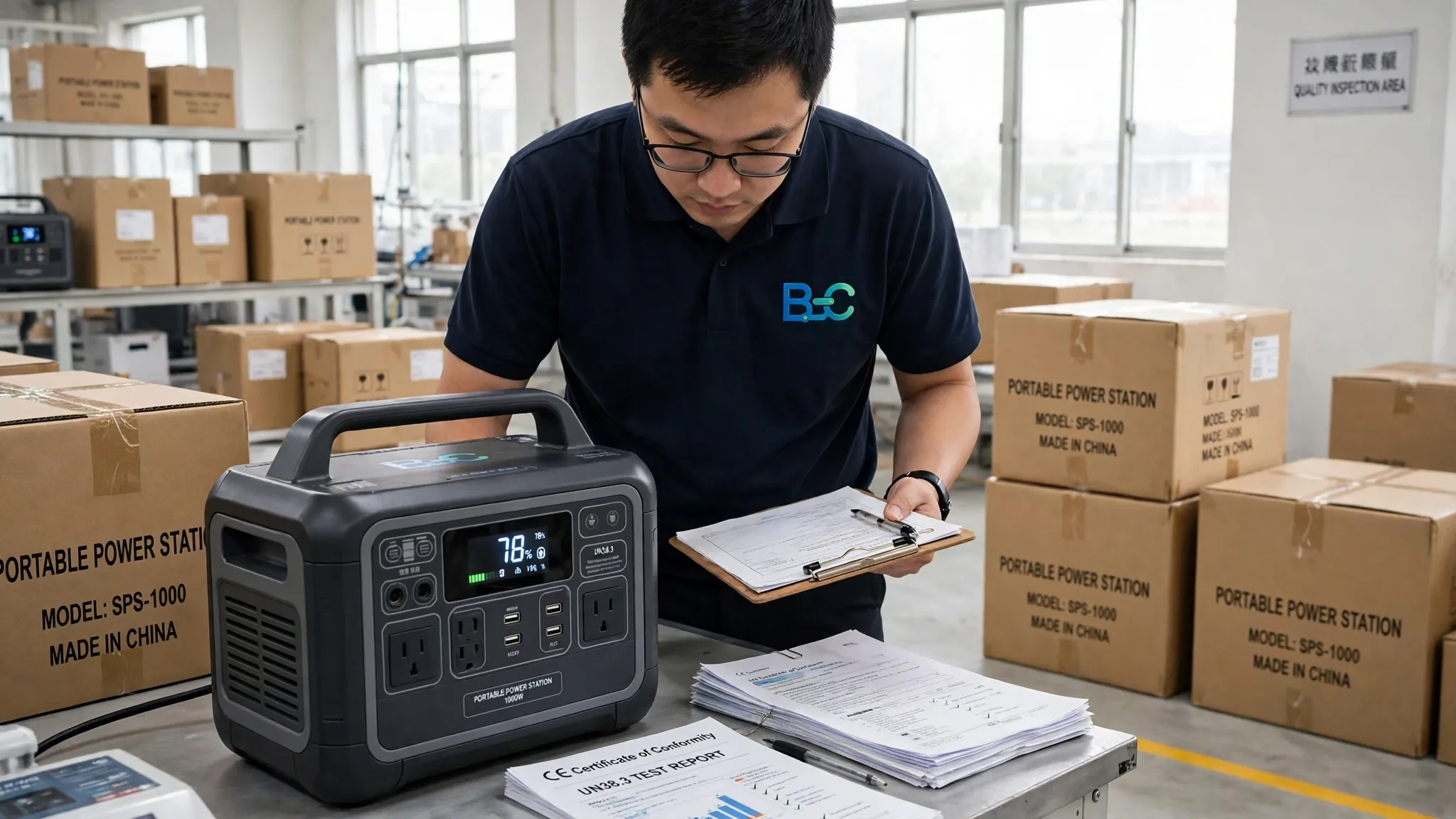
Portable power stations are one of the easiest products to buy badly from China. The listings all look alike — a box, a handle, a row of sockets, a wattage number in large type — and the price spread between two units with the same headline number can be enormous. The difference is rarely visible in the listing photo. It sits in three places buyers often check last: the battery cells inside, the certification documents behind them, and the shipping rules that decide whether the order can travel at all.
This is a product where the battery is the product. A power station is a battery with an inverter, a charger and a case around it, and almost everything that goes wrong in a sourcing order traces back to the battery: the wrong chemistry for the market, a test report that names a different model, a shipment a carrier refuses because the paperwork does not match the carton. Get the battery questions right and the rest of the order is straightforward. Get them wrong and the cheapest quote becomes the most expensive order you ever placed.
This guide walks through the three decisions in order: reading the specification, checking the certification stack, and choosing the shipping route. It is written for importers and brands buying their first — or their fiftieth — container of portable power stations from China.
Watts are not watt-hours: reading the spec sheet
The first confusion in this category is the two numbers that look interchangeable and are not. Watts (W) measure output power — how much load the unit can run at once. Watt-hours (Wh) measure stored energy — how long it can run that load. A 1,000W station with a 1,000Wh battery can run a 1,000-watt appliance for about an hour, or a 100-watt appliance for roughly ten. A 1,000W station with a 500Wh battery runs the same appliances for half as long. Same headline wattage, half the product.
Then there is peak power, sometimes printed larger than the rated output. Peak (or surge) power is the brief spike the inverter can survive when a motor starts — a fridge compressor, a power tool. It is not continuous-load capability. A station rated 1,000W continuous with a 2,000W peak is a 1,000W station. When a supplier's listing leads with the peak number and buries the continuous rating, that is a signal about the supplier, not just the product.
Three more lines on the spec sheet decide whether the unit suits your market:
- Waveform. A pure sine wave inverter produces clean AC power that runs sensitive electronics — laptops, medical devices, modern appliances — without risk. A modified sine wave inverter is cheaper and rougher; it can damage or overheat some equipment. Most buyers in the US, EU and Australia should treat pure sine wave as a baseline requirement, not an upgrade.
- Output standards. Voltage, frequency and socket type are market-specific. A unit built for the US market (110–120V, 60Hz) is not the same SKU as one built for the EU (220–240V, 50Hz), even when the case is identical. Confirm the destination-market version before you approve the order — the wrong socket configuration is discovered at the customer's home, not at the factory.
- Charging inputs. AC wall charging, solar (MPPT) input, car charging and USB-C PD are all separate features with separate ratings. If you are selling the unit as a solar generator, the solar input wattage and the panel compatibility matter as much as the battery. Ask for the solar charging time with a named panel wattage, not a best-case figure.
Ask the supplier to confirm these five figures in writing before you compare prices: continuous AC output, battery capacity in Wh, waveform, destination-market voltage and sockets, and solar input rating. Two quotes that agree on all five are comparable. Two quotes that agree only on the headline wattage are not.
LiFePO4 or lithium-ion? The cell chemistry decision
Most portable power stations use one of two lithium chemistries, and the choice shapes the product's weight, lifespan and safety story.
LiFePO4 (lithium iron phosphate) cells typically last several times as many charge cycles as standard lithium-ion (NMC) cells, run cooler under stress, and tolerate a wider range of conditions. They are heavier and bulkier for the same capacity, and they usually cost more per watt-hour. For home backup, off-grid and heavy-use products — the units a customer expects to keep for years — LiFePO4 has become the default expectation in most Western markets.
Standard lithium-ion (NMC) cells pack more energy into less weight, which suits compact and portable models where every kilogram matters. Their cycle life is shorter, and they need a good battery management system (BMS) to stay safe.
Neither chemistry is "better" in the abstract. The question is which one your customer expects at your price point, and whether the supplier's claim matches the cells actually inside. Cell brand and chemistry are the easiest things to substitute mid-order and the hardest to verify from overseas — which is why the inspection section below checks them explicitly. Ask for the cell manufacturer and model in the quotation, and make it part of the sealed sample record.
The certification stack: each document answers one question
New buyers often ask a supplier for "the certificates" as if it were one document. It is a stack of documents, and each answers a different question. A supplier who hands you one certificate and calls the matter closed has answered one question and left the rest open.
- UN38.3 test summary — can this battery travel? The UN Manual of Tests and Criteria, Section 38.3, sets eight transport tests: altitude simulation, thermal cycling, vibration, shock, external short circuit, impact and crush, overcharge, and forced discharge. The test summary is the one-page statement that a battery type passed them. It is a transport qualification, not a product safety mark — and it is the document a forwarder asks for first. Without it, the shipment does not move.
- MSDS / SDS — what is in it, and what do we do if it is damaged? The safety data sheet (16 sections) describes the chemistry, the hazards, and the handling and fire response. Carriers and customs brokers ask for it alongside the UN38.3 summary. Like the summary, it must describe the actual product in the carton, not a near relative.
- IEC 62133-2 — is this battery safe as a product? This is the international safety standard for portable sealed lithium cells and the batteries built from them. It is what a European retailer or a marketplace compliance team usually asks for. It answers a product-safety question; it does not answer the transport question, and a supplier who offers an IEC 62133-2 certificate in place of a UN38.3 summary has given you a real document about a different subject.
- CE and RoHS — can it be sold in the EU? The CE declaration states the applicable EU directives were applied; the RoHS report is a laboratory result on restricted substances. They are separate documents with separate purposes.
- UL 2743 and FCC — can it be sold in the US? US buyers and retailers commonly ask for UL 2743, the safety standard for portable power packs, and FCC compliance for electromagnetic compatibility. Japan (PSE), Korea (KC) and Australia (RCM) each have their own market-access marks. Confirm which marks your destination actually requires before you pay for testing you do not need — and before you skip testing you do.
The practical rule: ask for the full stack that matches your market before you pay the deposit, and check that every document names the model you are buying. Certificates are cheap to promise and slow to produce; a supplier who says "we will send them after production" is telling you the documents may not exist yet.
The mismatch trap: when the paperwork names a different unit
The most common documentation failure in this category is not missing paperwork. It is paperwork for a different product.
A UN38.3 test summary attaches to a battery type, not to a factory or a product family. The model number on the summary has to be the unit in your carton — same capacity, same cell, same configuration. A summary naming a 500Wh model does not cover a 1,000Wh model in the same shell. A summary for one cell type does not cover a unit built around a different cell. Under current IATA guidance, a design becomes a new type requiring fresh tests when the watt-hour rating changes by more than 20%, or when any change might materially affect the test results.
This is where a routine production decision becomes a shipping problem. A factory substitutes a cell to meet a deadline, or tweaks the pack layout to fix a fit issue, and the test summary no longer describes the product. Nothing was specified wrongly. The requirement simply never named the one attribute that decides whether the goods may travel.
Three checks close this gap:
- Ask for the UN38.3 test summary and the MSDS before the deposit, and read the model number, cell type and watt-hour rating against the quotation line by line.
- Put the cell manufacturer, cell model and pack configuration in the order contract, with a clause that any substitution requires written approval and fresh documentation.
- At pre-shipment inspection, confirm the battery label, the carton marking and the documents all carry the same model number and watt-hour figure. A mismatch found at the warehouse costs a phone call. A mismatch found at the port costs the shipment.
Shipping: the watt-hour rating decides the route
Lithium batteries are Class 9 dangerous goods under the IMDG Code for sea freight and under IATA rules for air. That classification is not a judgment on your product — it is the framework every carrier applies, and it sets the paperwork, packaging and routing for the whole shipment.
The details that matter for a power station order:
- UN number. Most portable power stations travel as UN3481 — lithium-ion batteries contained in equipment. Standalone battery packs travel as UN3480, the stricter category. The wrong UN number on the booking is one of the fastest ways to have it rejected.
- Watt-hour thresholds. The 100 Wh line is the number air carriers apply to spare lithium-ion packs, and almost every portable power station sits well above it. That is why sea freight is the normal route for volume orders. Air freight is possible for small-capacity samples through dangerous-goods channels, but it costs more, needs the full document set, and standalone batteries by air are generally limited to 30% state of charge under IATA rules.
- IMDG Code Amendment 42-24. Mandatory from 1 January 2026, this amendment tightened how the UN38.3 test summary must be made available along the chain, so that consignors and carriers can verify compliance. The practical effect for buyers is simple: summaries that used to be produced on request now need to be accessible before the booking. Build the document check into your order timeline, not your shipping week.
- China-side export documents. Beyond UN38.3 and the MSDS, a lithium battery export from China typically requires a Dangerous Goods Transport Identification Report (renewed annually) and a DG packing certificate for the export packaging. Your forwarder or agent should confirm these are in hand before the container is booked — not after it is loaded.
- Tariffs. Duties on Chinese lithium-ion batteries have moved more than once in recent years, in the US and elsewhere. Check the current rate for your market and product classification before you cost the order; the rate that applied last year may not be the rate that applies now. This is a costing question, not a reason to delay — it takes one check to answer.
None of this is a reason to avoid the category. It is a reason to treat shipping as part of the product decision, made at quotation time, rather than as an afterthought handled in the shipping week.
Before you pay: the checks that cost nothing and save the order
A portable power station order has more failure points than a simple consumer product, and most of them are cheapest to catch before the deposit moves:
- Verify the supplier. A background check on the factory's registration, export history and litigation record costs far less than a deposit sent to a trading company posing as a manufacturer. This is the single highest-return check in the order.
- Test a sample against the spec sheet. Run the appliances you intend to advertise, measure the actual runtime, and check the charging times. A sample that underperforms by 20% is a specification problem, not a sample problem.
- Seal a golden sample. The approved sample, with its cell type, BMS version and firmware noted, becomes the reference the production run is inspected against. Without it, "the same as the sample" is an argument, not a standard.
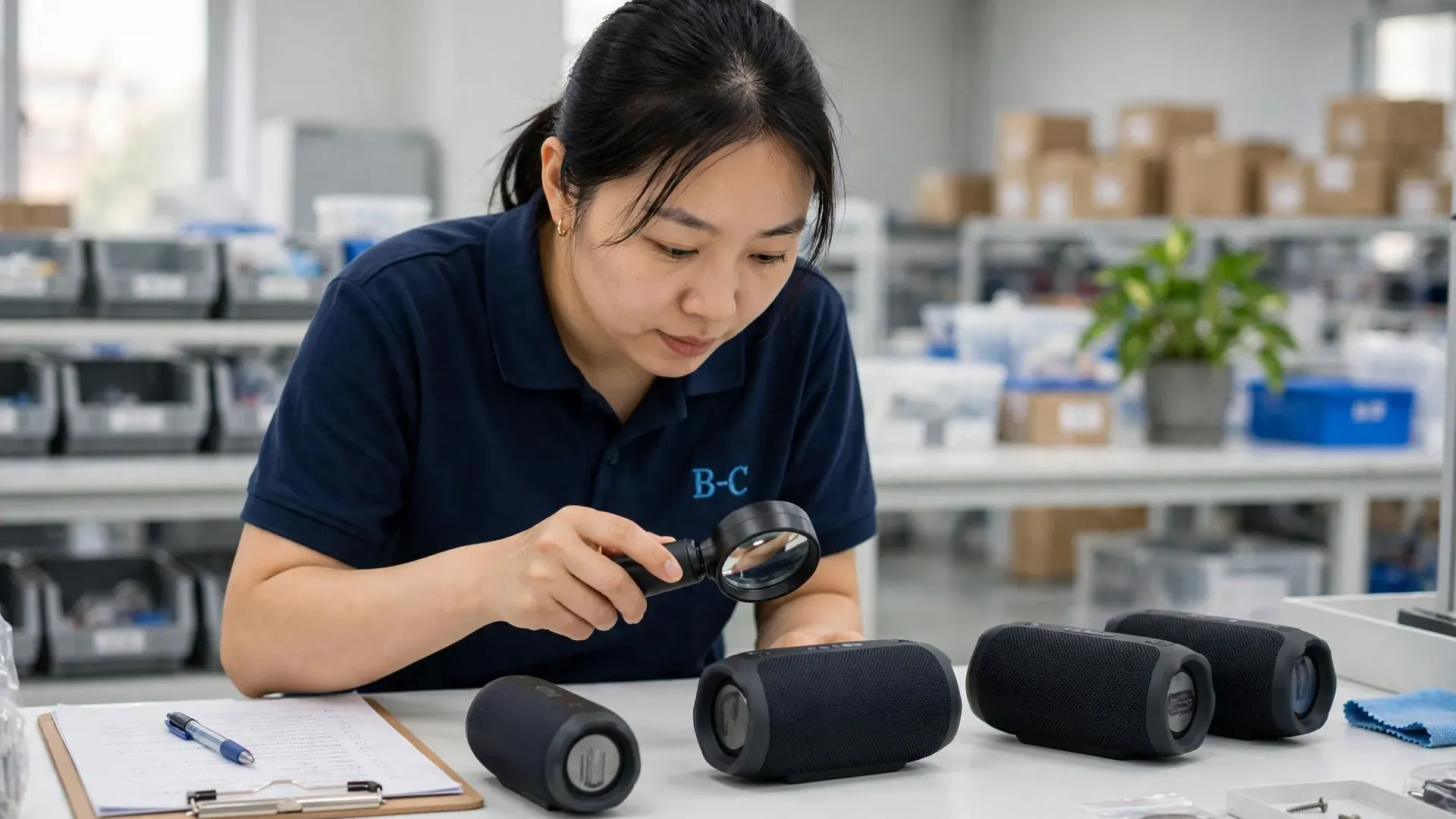
- Inspect before shipment. A pre-shipment inspection on a power station order checks the battery label and watt-hour marking, the outlet configuration for the destination market, the packaging and DG markings, and a function test on a sample of units — not just the carton count.
- Confirm the documents travel with the goods. The UN38.3 summary, MSDS and DG paperwork should be in the forwarder's hands before the vessel sails. Documents that arrive after the container do not help the container.
What we do differently
A sourcing agent earns the fee on this category in the gaps between the factory, the laboratory and the forwarder — the three parties who each assume the other has checked the paperwork.
We verify the supplier before any money moves, and we read the certification documents against the actual model being quoted, not the factory's catalogue. We seal a golden sample with the cell type and configuration recorded, and we inspect production against it — including the battery label, the watt-hour marking and the destination-market outlets. And we coordinate with the freight forwarder so the dangerous-goods documents are confirmed before the booking, not chased after it.
Because we consolidate orders across buyers and factories, a smaller importer gets the same document discipline as a large one: the checks do not shrink with the order size.
What we can and cannot do
We can verify a supplier's background and export history, check certification documents against the model you are buying, run sample testing and pre-shipment inspection, and coordinate compliant dangerous-goods shipping with a forwarder who handles lithium batteries regularly.
What we cannot do is ship a unit whose paperwork does not match the product, and we will not try. We cannot produce a test report for a battery that was never tested, and we cannot get a non-compliant battery onto a vessel or an aircraft by asking nicely — carriers check, and a rejected booking costs more than the wait for proper documents. If a factory's documents do not cover the model you want, we will tell you that before the deposit, and help you find a factory whose documents do.
The bottom line
Portable power stations reward buyers who read the battery before the price. Compare continuous output and watt-hours separately, confirm the cell chemistry your market expects, demand the certification stack that matches your destination, and treat the shipping rules as part of the product decision. The order that looks cheapest on the quotation is usually the one where one of those four checks was skipped — and the cost of the skip arrives at the port, not at the factory.
If you have a specification or a supplier quote for portable power stations, send it to us for a factory quote within 24 hours — and we will read it against the certification and shipping requirements for your market — including the checks most quotations leave out.
Related: Portable Power Stations — Outdoor Energy — our product page for portable power stations, covering the range we source and the configurations available for wholesale and private label.