Sourcing Silicone Baby Products from China: Food-Grade Silicone, LFGB and Mold Costs
Silicone baby products look simple, but food-grade silicone grades, LFGB and FDA rules, and mold costs decide whether your order passes customs and sells. Here is how to source them right.
Silicone baby products — feeding sets, bibs, teething toys, suction plates — look like some of the simplest products to source from China. The material is soft, the shapes are simple, and factories all over Guangdong and Zhejiang make them. That simplicity is misleading. A silicone bib that fails a food-contact test, a suction plate that does not actually suction, or a mold that was never built for your design can turn a small first order into a customs rejection, a platform takedown, or a warehouse full of unsellable stock.
The three things that decide whether a silicone baby product order succeeds are the grade of the silicone, the food-contact standard it must meet in your market, and the mold. Get those three right and the rest — colours, packaging, shipping — is straightforward. Get any one wrong and the order is at risk before it leaves the factory.
Not all silicone is food-grade
The first question to ask any supplier is not the price. It is: what grade of silicone is this, and how is it cured?
Food-grade silicone is made to come into contact with food and with a baby's mouth. It is produced from high-purity raw material with tightly controlled additives, and it is cured in a way that leaves minimal volatile residues. Industrial-grade silicone, which is used for seals, gaskets and mould-making, is cheaper and looks the same — but it is not made for food contact, and it should never be used for baby products.
Within food-grade silicone there is a second distinction that matters: how the material is cured. Platinum-cured silicone uses a platinum catalyst and produces a cleaner, more stable material with lower volatile content. Peroxide-cured silicone is cheaper and more common in low-end production, but it needs a thorough post-cure bake to drive off residues, and if that step is skipped or shortened, the finished product can carry an odour or fail a volatile-substance test. When a supplier's price looks surprisingly low, the curing method and the post-cure step are among the first places to look.
Ask the supplier to name the silicone grade and the curing method in writing, on the quotation and on the specification sheet. Ask for the material datasheet from the silicone supplier — not just the factory's own statement. A factory that buys its raw material from a named, reputable silicone producer and can show the datasheet is a different proposition from one that buys unbranded material and cannot say where it came from.
LFGB, FDA and the standard your market actually requires
Baby products that touch food are regulated as food-contact materials in every major market, and the rules are not the same everywhere. The two standards buyers ask about most are LFGB and FDA, and they are not interchangeable.
LFGB refers to the German food-contact regulation, Sections 30 and 31 of the German Food and Feed Code. It is one of the strictest food-contact regimes in the world: it tests for overall migration, volatile organic compounds, and specific substances, and it includes a sensory test — the material must not transfer taste or smell to food. A product that passes LFGB is generally accepted across the EU, and many EU buyers treat an LFGB test report as the baseline requirement for silicone feeding products.
FDA rules, under 21 CFR 177.2600, govern rubber articles intended for repeated food contact in the United States. The test requirements differ from LFGB — different extraction conditions, different limits — so a product tested only to FDA does not automatically meet LFGB, and vice versa. If you sell in both markets, you need testing for both.
Two further points matter for baby products specifically. In the United States, products intended for children under 12 fall under CPSIA, which adds limits on lead and phthalates and requires third-party testing and a Children's Product Certificate for children's products. In the EU, feeding products such as bottles, teething rings and tableware may fall under EN 14350, which covers materials, construction and performance requirements for children's feeding articles. The exact standards that apply depend on the product type and the market — confirm them with your compliance adviser and state them in the specification before you ask for a quotation, not after the goods are made. Rules change; where this article refers to a regulation, check the latest official text before relying on it.
When you request a test report, read it properly. A report is only as good as its scope: check that it names your product or the same material in the same formulation, that the tests match the standard your market requires, that the report is current, and that it comes from an accredited laboratory. A test report for a different product, a different material, or a test done three years ago does not prove your product complies. Ask the factory whether the quoted price includes testing for your target market, or whether testing is charged separately — and budget for it either way.
Mold costs: the line item buyers underestimate
Almost every silicone baby product is made in a mold, and the mold is usually the largest single upfront cost in a first order. Understanding how mold costs work prevents the two most common surprises: a quotation that looks cheap because the mold is not included, and a mold that cannot be reused for the next order.
A new mold for a silicone feeding set or bib is a steel tool, machined to your design. Its cost depends on the size and complexity of the product, the number of cavities (how many pieces each molding cycle produces), and the finish required. A simple single-cavity mold for a small item costs far less than a multi-cavity mold for a large suction-plate set with fine detail. The mold is normally paid for once and then reused for repeat orders, so its cost should be shown as a separate line on the quotation, not buried in the unit price.
Three things to settle in writing before the mold is cut. First, who owns the mold. If you paid for it, the contract should say so, and say where the mold is stored and what happens to it if you move production to another factory. Second, the mold trial: the factory should produce trial shots for your approval before mass production, and you should approve the trial pieces against the specification — dimensions, wall thickness, colour, suction performance, and any logo or detail. Third, the mold's life: ask how many shots the mold is rated for and who pays for maintenance or replacement if it wears out during your order.
Private molds also raise a design question worth settling early: is your design original, or is it a modification of the factory's existing mold? Using an existing mold saves the tooling cost, but the same shape may be sold to other buyers, and your product will not be exclusive. A custom mold costs more upfront and gives you a product that is yours alone. Neither choice is wrong — but the choice should be deliberate, and the exclusivity question should be answered in writing.
What to check before you approve a sample
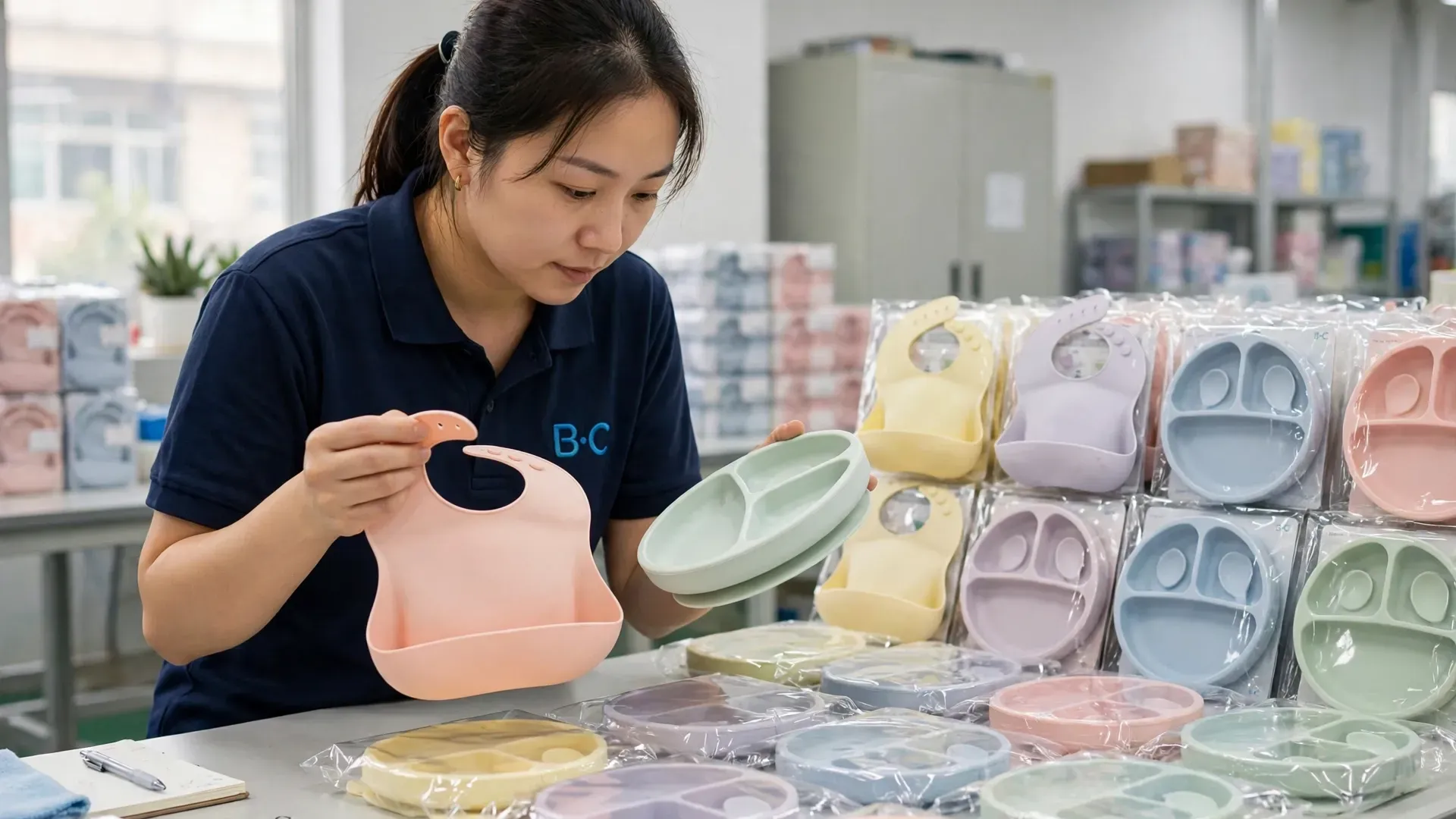
Samples are where most silicone baby product problems are caught — if you know what to look for. When the sample arrives, check these points before approving it for production:
First, smell and feel. Food-grade silicone should be odourless or nearly so, with a smooth, dry surface. A strong chemical smell, a greasy or sticky surface, or a product that attracts dust aggressively can indicate uncured material or a low-grade compound. This is not a laboratory test, but it is a useful first filter — and a sample that smells wrong should not be approved on the basis of a factory's reassurance alone.
Second, dimensions and weight. Silicone shrinks as it cures, so the finished piece is slightly smaller than the mold cavity. Check the sample against the drawing with calipers, and weigh it: a piece that is noticeably lighter than specified may have thinner walls than agreed, which affects durability and suction performance.
Third, function. A suction plate should hold on a smooth surface under the weight it is meant to carry. A bib pocket should hold its shape. A teething toy should flex without tearing at thin points. Test the sample the way a parent would use it — not the way a factory would demonstrate it.
Fourth, colour and finish. Check the colour against your approved swatch in daylight, look for flash (excess material at the mold parting line), air bubbles, and uneven thickness. Flash can be trimmed, but heavy flash or bubbles in the same place on every piece point to a mold or process problem, not a one-off defect.
Finally, confirm the sample matches the material you specified. If the specification says platinum-cured food-grade silicone and the sample was made with a different compound, no amount of visual approval makes the order compliant. If you are in doubt, send a sample to an independent laboratory for a material check before approving mass production.
If you need a supplier checked against these points before you commit, get a factory quote in 24 hours — send the product, the target market and the standard it must meet, and we will verify the material, the testing and the mold before you pay a deposit.
Packaging, labelling and the details that delay customs
Silicone baby products rarely face a tariff problem. They face a labelling problem. In the EU, food-contact silicone products need the correct food-contact symbol and material identification; in the US, children's products need the tracking information CPSIA requires; and in both markets, the packaging must not make claims the product cannot support — a "BPA-free" claim is standard for silicone, but any claim about antibacterial properties, medical benefits or developmental effects should not appear on baby products at all, and would create a compliance problem rather than a selling point.
Agree the packaging with the factory before production: the box or bag, the label content in the market language, the barcode, and any inserts. A product that is ready to ship but has the wrong label is a product that waits in the warehouse while new labels are printed.
What we can and cannot do
We can find factories that make food-grade silicone baby products, verify the silicone grade and curing method, confirm which food-contact standard applies in your market, arrange independent testing, negotiate mold ownership and trial-shot approval in writing, and inspect the goods before shipment — including a material and function check against the approved sample.
What we cannot do is certify a product ourselves, or guarantee that a test report from the factory's own laboratory will be accepted by your market's authorities. Testing must come from an accredited laboratory, and the final compliance decision rests with the regulator in your market. We also cannot make a low-grade material pass a food-contact test — if the material is wrong, the only fix is to change the material. And we cannot approve a sample on your behalf without your say-so on the design, colour and branding: those decisions are yours, and we will not guess them.
The bottom line
Sourcing silicone baby products from China is a materials and compliance exercise before it is a price exercise. The factories are there, the capacity is there, and the prices are competitive. The orders that go wrong are the ones where the silicone grade was never written down, the test report was never read, or the mold was treated as a detail instead of the largest upfront cost in the order.
Before you place a first order, get three things in writing: the silicone grade and curing method, the food-contact standard the product must meet and who pays for the testing, and the mold cost, ownership and trial approval. With those three settled, the rest of the order — colours, packaging, quantities, shipping — follows naturally.
If you are sourcing silicone baby products and want the material, testing and mold verified before you commit, get a factory quote in 24 hours — tell us the product, the target market and the volumes, and we will start with the supplier and material checks.
Related: Silicone Baby Feeding Set, Bib, Plate and Placemat — food-grade silicone feeding sets sourced from China with full inspection before shipment.