Ordering Samples from Chinese Suppliers: Costs, Timelines and How to Approve Them
A sample is the cheapest insurance in a China sourcing order — if it is the right sample and the approval is on record. This guide covers costs, timelines and how to approve one properly.
The most expensive sentence in China sourcing is "the sample was perfect." It is usually spoken by someone holding a production run that looks nothing like the sample — and the reason is almost always the same: the sample was never really approved. It was glanced at, liked, and paid for, with no written record of what was checked and no sealed reference to compare production against.
A sample is the cheapest insurance in a sourcing order. It costs a fraction of the deposit and answers the questions that no quotation can: does the product work, does the colour match, does the packaging survive, does the factory actually make what it quoted? But a sample only insures the order if it is the right kind of sample, checked against a written specification, and approved in writing with a sealed reference kept. This guide covers the three kinds of sample, what they cost and who pays, how long they take, and how to approve one properly.
The three kinds of sample
Not all samples are the same thing, and the differences matter for both cost and reliability:
- Stock sample. An off-the-shelf unit the factory already makes — the same product it sells to other buyers, in the same colours and packaging. Fast and cheap, sometimes free: it tells you what the factory's standard product looks like, and whether the quality is in the range you need. It does not tell you whether the factory can make your version of it.
- Custom sample. A unit made to your specification: your colours, your logo, your dimensions, your packaging. This is the sample that actually tests the factory's ability to deliver your order. It costs more and takes longer, because the factory is setting up for a product it has not made before — and the sample fee reflects real materials and labour, not just postage.
- Pre-production sample (golden sample). The approved sample, made from production materials on production tooling, that becomes the reference for the whole order. Once you approve it in writing, it is sealed and kept — one copy with you, one with the factory, and ideally one with your agent or inspector. Every production unit is then judged against it. Without a golden sample, "the same as the sample" is an argument, not a standard.
The common mistake is to treat a stock sample as if it were a golden sample: approving the factory's standard product and then being surprised when the customised production run differs. Each kind of sample answers a different question. Ask which question you are trying to answer before you order one.
What samples cost — and who pays
Sample costs have three parts, and buyers are usually surprised by which one is biggest:
- The sample fee. For a stock sample, this is often low or waived — the factory already has the product. For a custom sample, the fee covers materials and the labour of a small, non-production run. It is real work: a factory that makes your sample for free is either absorbing a cost it will recover somewhere, or not making your sample at all.
- The freight. Express courier freight for a small parcel from China is frequently more than the sample itself. A sample that costs a few dollars to make can cost several times that to ship, and the buyer almost always pays the freight. Factor it in before you order samples from five factories at once — the freight bill for five parcels is a real number.
- Tooling and moulds. If your product needs a new mould, a printing plate or a cutting die, the sample may need them too. Tooling costs are separate from sample costs and should be agreed in writing before the sample is made — including who owns the tooling if the order does not proceed.
Two points worth negotiating before the sample is ordered:
- Refundable against the order. Many factories will credit the sample fee against a production order. Agree this in writing before you pay — "we will see" is not an agreement, and it is rarely honoured after the fact.
- How many samples. One sample is enough to check the product; two or three let you keep a sealed reference and still have one to test, photograph or show a customer. Ordering a single sample and then cutting it open to check the inside leaves you with no reference at all.
How long samples take
Timelines depend on the kind of sample and the complexity of the product. As a rough guide:
- Stock sample: a few days to a week, mostly courier time. If a factory takes three weeks to send a stock sample, that is information about the factory.
- Custom sample: typically one to two weeks for a straightforward product, longer for anything with new tooling, custom electronics, or complex assembly. The factory's first estimate is usually optimistic — add a few days and you will rarely be disappointed.
- Pre-production sample: made once production is set up, so it comes after the order is placed. Its timeline is part of the production timeline, not separate from it.
Two things that slow samples down are worth knowing in advance. The first is that samples are made between production runs — your single unit waits behind the factory's paying orders. The second is that the courier leg is often the longest part of a stock sample's journey, and it is the part nobody controls. Order samples early, and do not plan a launch date around the fastest possible sample timeline.
How to approve a sample properly
Approving a sample is a process, not a reaction. Run it the same way every time:
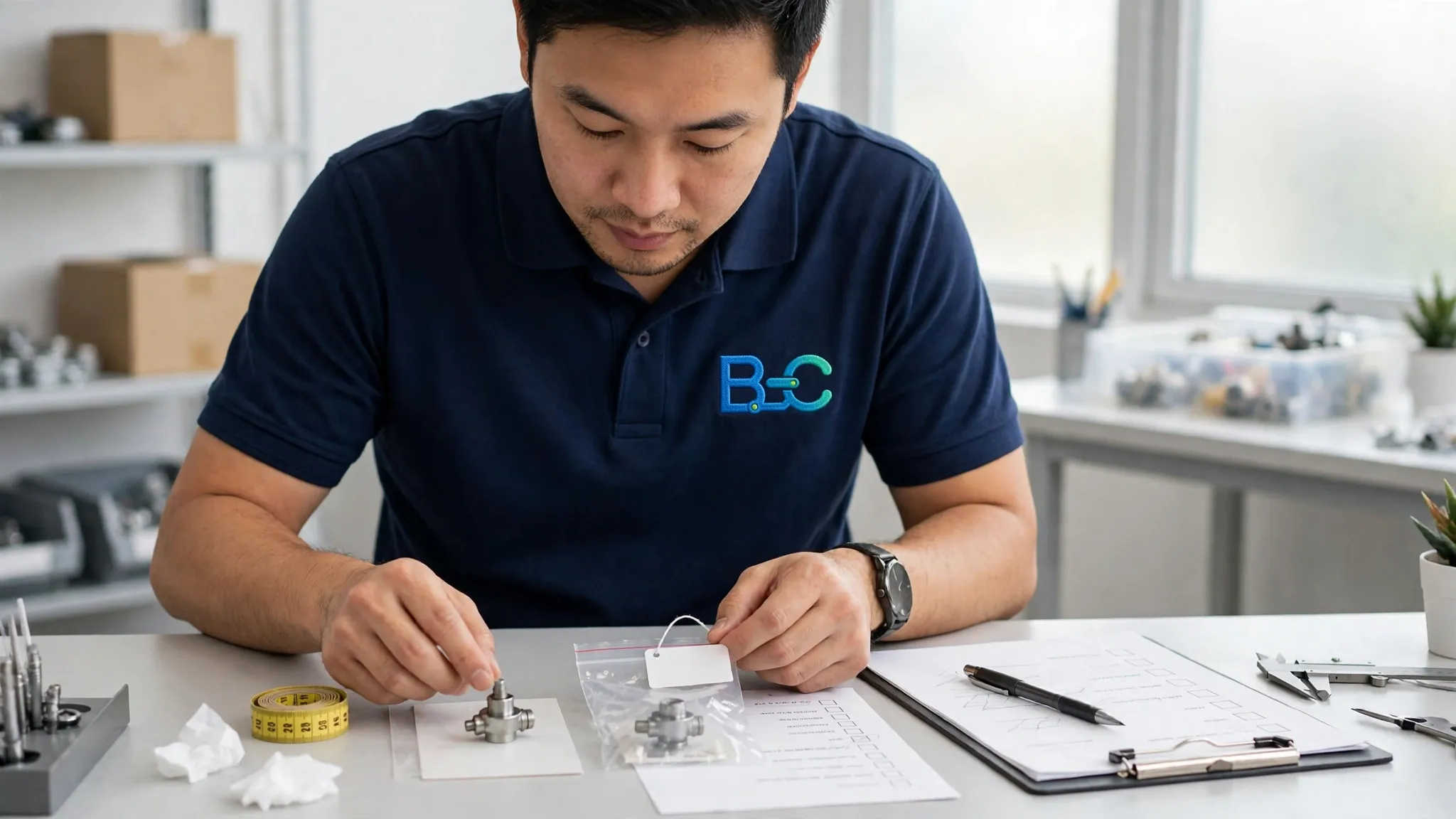
- Check it against the written specification. Dimensions, weight, materials, colours, function, packaging, labelling — each against the specification you sent, not against your memory of it. Measure, do not eyeball: a 2 cm difference in a bag's strap is invisible in a photo and obvious to a customer.
- Test it the way the customer will use it. Open it, close it, wash it, charge it, drop it from table height. A sample that survives your desk test will survive most customers; a sample that fails it will fail them too.
- Photograph everything, including the problems. Photograph the sample next to a ruler, the label, the packaging, and every defect you find. Photographs are the record that survives the shipment; memory does not.
- Write the verdict down. Approve or reject in writing, listing what was checked and what needs to change. "Looks good" in a chat message is not an approval — it is a sentence nobody can act on. A written approval with a list of required changes is a document the factory can work from and the inspector can check against.
- Seal the golden sample. Once a sample is approved, seal it — a signed label, a dated note, a record of the specification it was approved against — and keep it somewhere it will not be used, lent or lost. One copy with the factory, one with you, and one with your agent or inspector if you have one. Production is then inspected against the sealed sample, not against anyone's recollection of it.
The traps
Three sample traps account for most of the disputes we see:
- The "best workers" sample. The sample is made by the factory's most skilled workers, from the best materials, with no time pressure. Production is made by the normal line, at normal speed, from the normal material batch. The gap between the two is the gap between the sample and the shipment. A golden sample made from production materials, on production tooling, closes most of this gap — which is why the pre-production sample matters more than the first custom sample.
- Approval without a reference. The sample is approved by message, used as a desk decoration, and lost before production starts. When the shipment differs, there is nothing to compare it against and no written record of what was approved. The sealed sample and the written approval exist precisely for this moment.
- The sample that is never quite final. Each round of changes produces a new sample, each new sample produces new comments, and the order never starts. Set a limit: two rounds of sample revision for a standard product, with the changes written down each time. A factory that cannot get it right in two rounds is telling you something about the order, not about the sample.
What we do differently
Sample coordination is unglamorous work, and it is where most sourcing orders quietly fail — the sample was fine, the approval was not, and nobody kept the reference.
We coordinate the sample with the factory, check it against your written specification when it arrives at our office — dimensions, materials, colours, function, packaging — and send you photographs and a written report rather than a thumbs-up. When you approve, we seal the golden sample and keep it at our office as the inspection reference, so the production run is checked against the sample you approved, not against a description of it. And because we are in Shenzhen, the sample loop is days, not weeks: a revision goes back to the factory the same week it is requested.
What we can and cannot do
We can coordinate stock and custom samples, check them against your specification with photographs and a written report, negotiate sample fees and refund terms with the factory, seal and hold the golden sample, and inspect production against it.
What we cannot do is approve a sample for you — the approval decision is yours, and we will give you the information to make it rather than make it in your place. We cannot make a factory produce a sample faster than its production schedule allows, and we will not rush a sample that needs a second round — a bad approval is worse than a slow one. And we cannot guarantee that production will match the sample perfectly: materials vary between batches, and the inspection exists to catch the variation that matters.
The bottom line
Order the right kind of sample, check it against a written specification, approve it in writing, and seal a golden sample before production starts. Those four steps cost almost nothing and prevent the most common sourcing dispute there is. The sample is not a formality before the real order — it is the real order, in miniature, and it deserves the same discipline.
If you have a product specification and want samples coordinated and checked before you commit to a factory, send it to us for a factory quote within 24 hours and we will run the sample process with you — including the written approval and the sealed reference most orders skip.
Related: B2B Sourcing from China — our sourcing service for importers and brands, covering supplier verification, sample coordination, quality inspection and compliant shipping.