AQL 2.5 Explained: Setting Acceptance Limits Before Your China Inspection
AQL 2.5 is a sampling rule, not a quality promise. This guide explains the Level II sample table, defect classes (Critical 0 / Major 2.5 / Minor 4.0), and why limits must be agreed before production.

"AQL 2.5" appears in almost every purchase order for goods made in China — and it is misunderstood in almost every one of them. Most buyers read it as a promise: no more than 2.5% of the goods will be defective. It is not that. It is a sampling rule, and the difference between the two readings is the difference between a shipment you can accept with confidence and a dispute you cannot win.
AQL stands for Acceptable Quality Limit (in the current standard, Acceptance Quality Limit). It is the worst process average a buyer is willing to accept over a series of lots — not a guarantee about the lot in front of you. An inspection under AQL 2.5 does not check every unit. It checks a sample, counts the defective units in that sample, and accepts or rejects the whole lot on that count. Whether your lot passes depends on three numbers you must agree before production starts: how many units are inspected, how many defective units are still a pass, and how many are a fail. This article explains all three, and why the time to settle them is before the factory starts cutting — not when the goods are already packed.
What AQL 2.5 actually means
Take a concrete order: 1,000 pieces, inspected at AQL 2.5 under the standard plan (General Inspection Level II, normal inspection, single sampling). The plan inspects 80 pieces picked at random. If 5 or fewer of those 80 are defective, the lot passes. If 6 or more are defective, it fails.
Notice what that means in practice. A lot can pass with 5 defective units in a sample of 80 — that is 6.25% of the units checked. The plan is designed so that a lot whose true defect rate is around 2.5% will usually pass, and a lot whose defect rate is far above that will usually fail. It is a statistical filter, not a certificate that every unit is good. A passed lot can still contain defective units; a failed lot can still contain mostly good ones. The plan controls risk on both sides — the buyer's risk of accepting a bad lot, and the factory's risk of rejecting a good one — and neither risk is zero.
That is why the first rule of AQL is the least glamorous one: the plan belongs in the purchase order, in writing, before production. An AQL agreed after the goods are finished is not a standard. It is a negotiation, and the side with the finished goods in its warehouse usually wins it.
The table: how many to inspect, how many may fail
The sample size is set by two things — the lot size and the inspection level — not by preference. General Inspection Level II is the default for most consumer-goods inspections, and it is the level this article uses throughout. Find your lot size, read across, and those three numbers are your plan.
| Lot size (pcs) | Sample inspected | Accept (Ac) | Reject (Re) |
|---|---|---|---|
| 91–150 | 20 | 1 | 2 |
| 151–280 | 32 | 2 | 3 |
| 281–500 | 50 | 3 | 4 |
| 501–1,200 | 80 | 5 | 6 |
| 1,201–3,200 | 125 | 7 | 8 |
| 3,201–10,000 | 200 | 10 | 11 |
| 10,001–35,000 | 315 | 14 | 15 |
| 35,001–150,000 | 500 | 21 | 22 |
ISO 2859-1 / ANSI/ASQ Z1.4, General Inspection Level II, normal inspection, single sampling, AQL 2.5 (major defects). Confirm the numbers against the current edition of the standard when you write them into a contract — the standard is revised, and the edition named in your purchase order is the one that governs.
Two things in this table surprise first-time buyers. First, the sample does not grow in proportion to the lot: a 1,000-piece order inspects 80 units, and a 10,000-piece order inspects only 200. That is the point of sampling — the cost of inspection stays manageable while the statistics stay sound. Second, the accept number is never zero at AQL 2.5 for a normal lot. If your product cannot tolerate any defect of a given kind, that kind does not belong under AQL 2.5 at all. It belongs under a different rule, which is the next section.
Defect classes: not all defects count the same
AQL 2.5 on its own says nothing about which defects matter. That is decided by classifying defects before inspection, and the classification is where most inspection disputes are actually born. The standard split is three classes:
- Critical — AQL 0. A defect that makes the product unsafe, illegal, or unusable for its purpose: a live wire exposed, a children's product with a detachable small part, a missing safety certification mark. The accept number is zero. One critical defect in the sample fails the lot. There is no percentage allowance for safety.
- Major — AQL 2.5. A defect that makes the product unsellable or likely to be returned: a zipper that does not close, a print in the wrong colour, a missing component, a function that does not work. This is the class the AQL 2.5 numbers in the table above apply to, and it is the class most buyers mean when they write "AQL 2.5" in an order.
- Minor — AQL 4.0. A defect a customer would notice but probably still accept: a small scratch on a non-visible surface, a slightly uneven stitch, a faint mark on packaging. Minor defects get a looser limit — the same sample of 80 from a 1,000-piece lot accepts 7 minor defects and rejects at 8 — because rejecting a whole shipment over a scuff nobody would return is not quality control, it is waste.
The common practice, and the one we use, is written as Critical 0 / Major 2.5 / Minor 4.0. But the numbers are the easy part. The hard part is the defect list itself: the specific defects, with photographs, that count as critical, major, or minor for your product. A scratch on a phone case is minor; the same scratch on a mirror is major. A loose thread on a tote bag is minor; a loose thread on a seam that carries weight is major. No generic list can decide that. The list must be agreed with the factory, in both languages, against the golden sample, before production — the same discipline described in our guide to following an order through production, milestone by milestone. An inspection without an agreed defect list is an argument waiting for a sample to happen.
The four mistakes that void an AQL inspection
1. Sampling from the top of the pile. A sample is only random if every unit in the lot has the same chance of being picked. Cartons opened from the top of the stack, units taken from the first pallet, or a factory that "helpfully" pre-selects the sample are all the same failure: the inspection measures the best units, not the lot. Random sampling means sealed cartons chosen by number, from different pallets, opened on the spot.
2. Counting defects instead of defective units. In the standard plan, Ac and Re count defective units, not individual defects. A unit with three minor scratches is one defective unit. Counting defects inflates the failure count and rejects lots the plan would pass — and hands the factory a legitimate reason to dispute the result.
3. Setting the standard after the goods are made. An AQL, a defect list, and an inspection level agreed at the pre-shipment stage are a renegotiation, not a standard. The factory has already optimised its production to a different, unstated bar, and any failure now becomes a discussion about who pays for rework on finished goods. The cost of agreeing the plan late is paid in exactly that discussion, every time.
4. Using AQL 2.5 where it does not belong. AQL sampling is a plan for ordinary commercial quality. It is not a safety certification, not a test of materials, and not a substitute for a functional or compliance test where one is required. A product that needs a lab test — a battery, a children's product, anything with a regulated substance — still needs that test. A passed AQL inspection says the lot is acceptable on the attributes inspected. It says nothing about the attributes nobody checked.
What happens when a lot fails
A failed lot is not automatically a cancelled order, and treating it as one is usually the most expensive option. The normal sequence is: sort and rework, then re-inspect. The factory sorts the lot, repairs or replaces the defective units, and the lot is presented again — usually under a tightened plan, with a larger sample, because a lot that has already failed once has earned closer scrutiny. The switching rules in the standard formalise this: repeated failures move inspection from normal to tightened; sustained good performance can move it to reduced.
What matters commercially is who pays for the rework and the re-inspection, and what happens to the delivery date. All three should be in the purchase order before production: rework at the factory's cost when the failure is a manufacturing defect, re-inspection charged to the party at fault, and the balance payment released only after the lot passes — the same linkage we describe in our guide to paying Chinese suppliers safely. Without that linkage, a failed inspection is a report. With it, it is a lever.
What we do / what we do not do
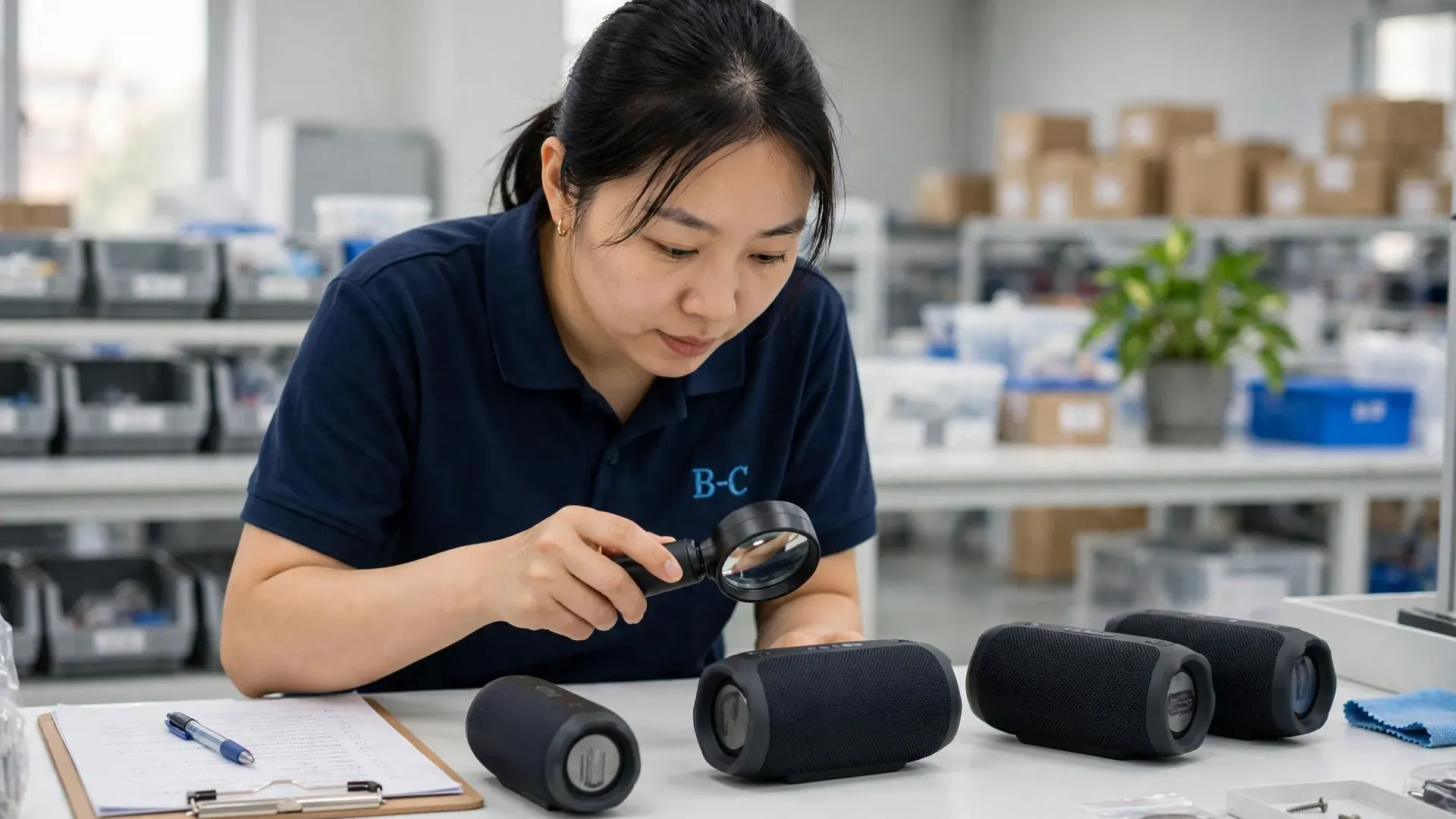
This is the stage our on-the-ground inspection exists for. After our customer service team replies within 24 hours, a named project manager follows the order, and our local team inspects at the factory — not from photographs the factory sends. We pull the sample ourselves, from sealed cartons across different pallets, against the defect list and the golden sample agreed before production, and report in English with photographs, a pass / fail judgement per defect class, and a recommendation: accept, rework and re-inspect, or reject. The balance payment stays tied to that result. That is the practical difference between an inspection and a forwarded factory update — one is someone checking the work, the other is the factory grading its own homework. Our full factory audit and supplier verification guide explains the checks that come before inspectionstarts. Start with a free supplier background check.
The one-line version
AQL 2.5 is not a quality promise. It is a contract about how quality will be judged: how many units get checked, how many defective ones still pass, and which defects count. Agree those numbers — and the defect list behind them — before production starts, write them into the purchase order, and the inspection at the end becomes a formality. Leave them until the goods are packed, and the inspection becomes a negotiation you will usually lose.
If you are placing an order in China and want the acceptance standard set before production — defect list, sampling plan, and inspection tied to your balance payment — send us the product and the order quantity through the inquiry form or on WhatsApp/WeChat at +86 185 9426 5439. We reply within 24 hours with a factory quote and the inspection plan that goes with it. get a factory quote within 24 hours.